Being woke is ruining reading

We’re not saying being woke is a bad thing, but it stinks when you suddenly can’t stand books or authors you used to enjoy. We read to escape, darn it, and here comes our sociopolitical awareness jolting us out of a nice fantasy. So rude!

This has been happening a lot with romance novels lately. Romance novels are the epitome of escapism. No other section in the book store offers quite the same level of pure fun—and we say that as card-carrying SFF and manga buffs. Sci-fi, fantasy, and comics—at least the kind we enjoy—all ask you to think on some level. Even fantasy romps like Piers Anthony’s Xanth series have a cleverly concealed commentary on society. So does Ranma 1/2. Marvel and DC’s comics do, too.

Romance novels, on the other hand, usually conform very closely to social norms. They uphold the “one true love” ideal and a whole bunch of other nonsense.

Case in point: we were listening to Selkies are a Girl’s Best Friend by Molly Harper. (No, that is not our typo. That’s the published title. Shame on whoever edited it!) Molly Harper is good with the snark and we were looking forward to another laugh out loud installment. And then the main character, Sophia, has an inner monologue in which she submits to societal pressure to settle down and have kids with a guy she has only known for a few days and initially hated. Cue our inner monologue saying, “This is ridiculous and unhealthy. We’re returning this book.”

We’ve also been listening to Ravenheart by Dannika Dark, the second novel in the Crossbreed series. This series is more action murder mystery in an urban fantasy setting than romance and it’s also full of snark. At one point our heroine Raven goes on a date with Detective Glass. Glass insists on ordering for her and overrules her saying she’d prefer a chicken salad. At which point we’re wondering why she doesn’t get up and leave. After the date Raven’s internal monologue is all about how she liked Glass being dominant (we’d call that being a domineering asshole). This is way out of character for Raven, who we expected was only dating Glass to get close to the investigation and piss off her work partner Sebastian. But it does support toxic social norms around masculinity and romance. We’re not sure yet if this is a blip in an otherwise enjoyable series.

We are wondering if outgrowing romance novels is a mark of emotional maturity, of being ready to set those toxic norms behind us.

Thoughts welcome.

Changing Coasts

This weekend I realized that I’ve been setting my story in San Francisco when I’ve been visualizing it in NYC. D’oh! I’ve been imagining House Ibsen’s exterior as an old brownstone. While this wouldn’t have been an insurmountable problem, many of my characters work in film and fashion, and these industries are much larger in the Big Apple. I’m working with a Fall 2001 time frame because I know I want Hurricane Katrina to take place during the second novel. This means 9/11 will play a larger role than I’d originally planned.

Most of all this means that all the background work I’ve done on setting my first novel in San Francisco—divvying up the city into territories, choosing real world locations for certain scenes, etc.—has to be redone for NYC. Hopefully I’ll be able to use the SF background I’ve developed for a later installment. I don’t know where my characters will take me after Hurricane Katrina, but they’ll probably hit the West Coast eventually.

I’m happy I caught this now! I feel a little foolish, but it can be difficult to get out of our own heads and see the gaps in our thinking.

Have you had to make a similar turn-around in your writing? Please tell me about it in the comments!

Audiobooks are Tricky Critters

I really enjoy audiobooks. Over the last few years I’ve read more books using my ears than my eyes! But audiobooks are tricky critters.

An audiobook makes you pay attention to every word. There’s no skimming long pastoral sections to get to the action. This can either make you appreciate hidden gems in these sections, or underline a writer’s weakness. We do need description, world-building, and character backgrounds, but it takes skill to smoothly incorporate these into a narrative without bogging it down. Whenever I listen to Katherine Kerr’s Deverry series, I find clever elements I’d overlooked in print.

Stories also have a rhythm to them. There are down or quiet moments in between the heart-hammering up scenes. Many writers are weaker in one of these tempos and audiobooks bring this out.

For example, while I wouldn’t say that Robert Jordan is necessarily weaker in one tempo, I did notice that The Eye of the World’s rhythm matched The Lord of the Rings’ almost point for point. This was so distracting, I couldn’t enjoy the story.

These are just a couple of the reasons it’s a good idea to record your completed draft and listen to it. What eludes you on the page will jump out at you on audio.

Once you have a polished tale, audiobooks can still play you false.

Professional editors will tell you it’s better to just use “said” in dialogue, especially lengthy dialogue. They reason that it’s easier on the reader because said fades into the background. But if you’re an audiobook reader, a lot of “said”s in a short span is repetitive and grates on the ears. At least on my ears. 🙂 I vastly prefer writers with a more varied approach to dialogue.

The voice actor who reads your work is important as well. And authors generally have no say in the casting process unless they’re reading themselves. For example, I recently listened to American Gods by Neil Gaiman on CD. A friend had recommended the TV show to me and I didn’t like it. I decided to see if the book was better (it definitely was!). I’m not sure I got the full impact of it, though. The reader’s voice had this Lake Wobegone quality to it that sucked all the extremes out of the narrative. The result was rather ho-hum. And ho-hum is generally the last word people use for Neil Gaiman’s writing.

Audiobook companies are also notorious for switching narrators in the middle of a series. Occasionally this is a good thing because the first reader was dreadful. Most of the time it gets the readers up in arms. We’ve grown accustomed to associating a certain voice with the series and its characters. It’s really jarring to change that and throws most readers right out of the story.

In a recent example, Lorelei King has read all of Patricia Briggs’ Mercy Thompson series until the most recent addition, Silence Fallen. In Silence Fallen Lorelei King still reads the chapters from Mercy’s point of view, but a male narrator now reads chapters from Adam’s point of view. I didn’t like it, but had finally started to get used to it when, for example, the female narrator would pop in to the male section to let us know time was passing differently for each character. That was so jarring! I honestly don’t know why audiobook companies persist in doing this kind of thing.

To sum up, I think it’s wise for writers to keep the audio version in mind. And maybe insist on casting control in your contract. 😉

It’s NaNoWriMo Time!✍🏻

November is National Novel Writing Month, NaNoWriMo for short. You can click on the link above to join in all the fun!

I’m not sure I’ll be doing NaNoWriMo myself this year. I’m at a place where I need to really nail down a lot of background stuff, like the various supernatural entities’ biology and cultures. I have it in my head, but I want to get it all written down so I can easily reference for consistency. I’m also one of those writers who uses science to make the magic as plausible as possible. I base my creatures as much in our known world as I can, down to figuring out the carrying capacity for vampires to ensure their population statistics are reasonable.

NaNoWriMo is based on word count. The goal is to write a 50,000+ word novel by the end of the month. But the background stuff I’m working on doesn’t contribute to my novel’s overall word count. So depending on how quickly that goes, I may not participate this year.

And I think we’ve all learned this last week that I have trouble with energy management. 😓 Chronic pain and illness make it really hard. But that’s another post.

If you are participating in NaNoWriMo this year, I’d love to cheer you on! Let me know your NaNoWriMo handle and the project you’re working on in the comments so I can find you on the website.

✒️Choose your weapon carefully… and let the adventure begin!

My Monster, the Vampire

It’s Friday, October the thirteenth today! (Pro tip: not the day to schedule your secret society meeting. 😉) That makes this the perfect day to blog about vampires.

Why vampires? For one thing, they’re at the core of the novel I’m writing, House Ibsen. There are lots of other classic monsters, too, like werewolves and witches and trolls (oh my! 😉), though the focus is on vampires.

But the real reason is that vampires are my monsters.

You see, every Fall I’d dread October’s arrival. The horror genre took over the airwaves. You couldn’t turn on the TV without seeing some sort of monster. I have always been prone to night terrors, the kind of nightmares where you thrash about and scream in your sleep. One time I backhanded my babysitter in the face mid-nightmare, but that’s another story.

Every October for years I’d have a nightmare that I was trapped in a treehouse and vampires were coming to get me. Every year like clockwork. It scared the bejeezus out of me. I can’t remember if it started before the The Simpsons’ “Treehouse of Horror” episode or not.

It finally stopped recurring sometime in junior high when I realized why I was particularly terrified of vampires; vampires are real and I was surrounded by them in my daily life.

I don’t mean that I was literally surrounded by the bloodsucking undead. I mean that many of the people in my life were like vampires. These people drained their victims of energy, money, and power. In psychology terms, they were toxic people high on the malignant narcissism scale. I believe that vampires function as a metaphor for humans who abuse power and prey on others.

I’ve read a lot of scholarly twaffle about vampires representing fears of blood borne disease and promiscuity. I don’t buy it. It makes much more sense to me that werewolves represent fears of infection (and being preyed upon by animals). The promiscuity angle comes from vampires and toxic people both using seduction to lure prey.

I have come to have a greater appreciation for vampires and worked on desensitizing myself. My best friend Matt helped. We’d rent vampire films and mock them mercilessly.

But I’m still afraid of vampires. They’re my monster because they continue to pop up in real life. They also continue to be the number one boogie man in my dreams. In fact, I was inspired to start writing HouseIbsen by a terrible nightmare involving vampires.

Which monster is your monster?


Bonus tidbit: one of my grandfathers believed Friday the 13th was his lucky day because good things always happened to him on that date. Specifically, he disembarked safely in Europe in World War II, returned home from the war, and died having a great day on the golf course, all on Friday the 13th.

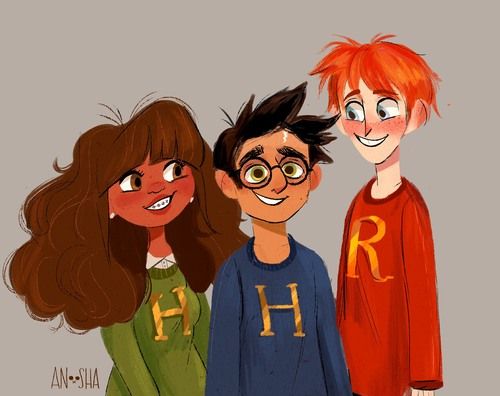
Fan art illustration of Hermione, Harry, and Ron from the Harry Potter series by Anoosha Syed.

Dear J. K. Rowling: I’m Confused

I was surprised when I came across this article on the BBC News website: “Backlash over illustrator’s black Hermione fan art”. And then I was confused.

Fan art illustration of Hermione, Harry, and Ron from the Harry Potter series by Anoosha Syed.

Anoosha Syed’s black Hermione is super cute! But, alas, confusing.

First, I’d like to say that writing a diverse cast of characters with regard to ethnicity, sexuality, gender identity, and so on without making it the focus or raison d’être is one of my goals. I’ve run into some problems because I’m untangling racism I didn’t realize I’d imbibed growing up and because it can be difficult to write the other, let’s be real. I’ve had to realize that you can’t please everybody and I just have to do my best to navigate these issues.

Now, Anoosha Syed argues that J. K. Rowling never states what race Hermione Granger is in the books. The closest she comes is one line in The Prisoner of Azkaban in which her skin is described as brown. So it’s not surprising that readers of all ethnicities would assume that she was their ethnicity. When done consciously, this process is called disidentification. When unconsciously, it’s called ethnocentrism. Syed further argues that Rowling selected a black woman, Noma Dumezweni, to play Hermione in the stage version. The author also retweeted her fan art, giving it the seal of approval.

Rowling’s actions are legitimately confusing for fans. She also selected Emma Watson, a white girl, to star in the film versions. Much was made of Rowling’s power to ensure accuracy in the films. And yet I’ve always been bothered by many inaccuracies that weren’t demanded by changing the medium. For example, in the books all of the Dursleys are clearly described multiple times as blond. Yet in the films they are brunettes. If the actors playing the Dursleys were the best available for the parts, hair dye or wigs could have easily fixed this problem.

So does Rowling herself not have a clear vision of what her characters look like? Does she just not care? Is she content to have multiple versions of her characters?

In a June 5, 2016 interview with The Guardian she says, “It was 17 years and just because I’ve stopped on the page doesn’t mean my imagination stopped.” So if the world of Harry Potter is still vivid in her mind, which casting choice better reflects her imagination?

In the same interview, Rowling addressed the controversy directly. “I decided not to get too agitated about it and simply state quite firmly that Hermione can be a black woman with my absolute blessing and enthusiasm,” she said.

“Can be a black woman.” (Emphasis mine.)

This wording suggests that Hermione was not originally a black woman in Rowling’s imagination, just that she’s okay with her character being portrayed as multiple races. She does not definitively state what ethnicity she had in mind when she wrote the Harry Potter series. So with the evidence at hand, I must conclude that Emma Watson best reflects Rowling’s vision. Watson was cast first and Rowling insisted the film accurately portrayed the books.

I understand Rowling’s impulse to embrace a more multicultural version of her characters. In essence, she is rewriting the Harry Potter series with her choices. And perhaps she didn’t have as much control over the films and play as purported. We’ll never really know. But I think a better and less confusing choice would have been acknowledging a black Hermione is a brilliant idea she wished she’d thought of, and then working to write with a wider color palette.

The Internet of Risky Things

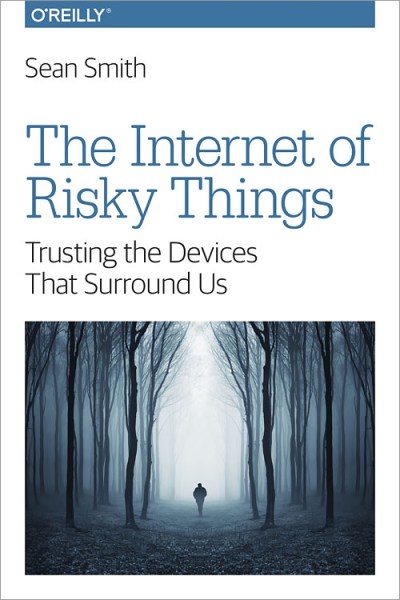
The Internet of Risky Things: Trusting the Devices that Surround Us by Sean Smith

The Internet of Risky Things: Trusting the Devices that Surround Us by Sean Smith

I’ve been trying to beef up my IT knowledge so I can make sure all the nifty things I want to do in my novel in progress, House Ibsen, are grounded in reality. So when I saw The Internet of Risky Things at the library, I pounced.

The book is very well-written and does an amazing job of striking the balance between detailed technical information and sufficient background material. My big overall takeaway: if you care about privacy, don’t use the Internet of Things. The amount of things that can—and probably will—go wrong is staggering! Author Sean Smith describes the issues with legacy components, the current “program now, patch later” paradigm, and security. For example, many Internet of Things devices use out-of-date components because they’re cheaper. Many of these components have bugs, but can’t be patched. Even if they can be patched, eventually they become so “old” that they’re no longer supported. This leaves millions upon millions of devices wide open to hackers. Especially when these devices are used for mission critical applications, like the power grid or pacemakers, that risk is unacceptable. Yet it runs rampant throughout the Internet of Things. Gives me the heebie-jeebies, I tell you.

On the other hand, as a writer this gives me lots of ways for both my bad- and good-guy characters to exploit Internet of Things weaknesses and make things…interesting. 🙂

THE BOTTOM LINE:

teacup1teacup5teacup4teacup3teacup2

If you’re interested in this field, I highly recommend reading The Internet of Risky Things.


Smith, Sean W. The internet of risky things trusting the devices that surround us. S.l.: OReilly UK Ltd, 2017.

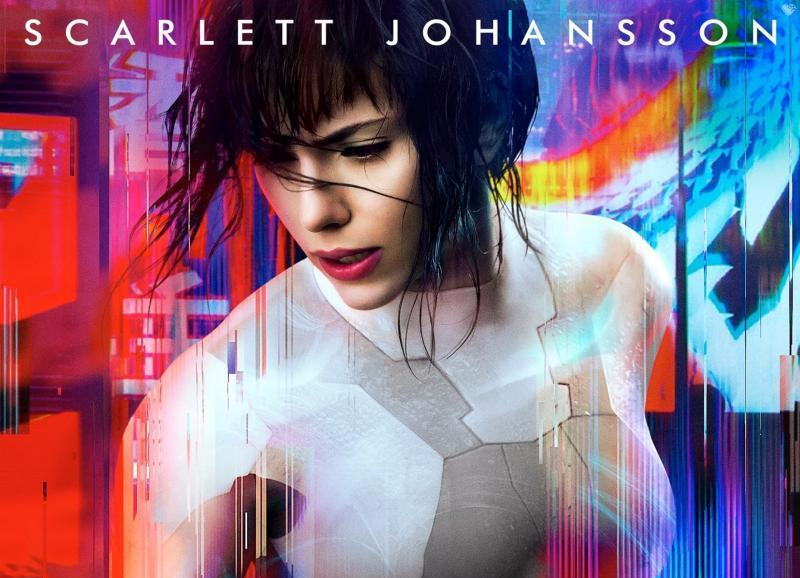
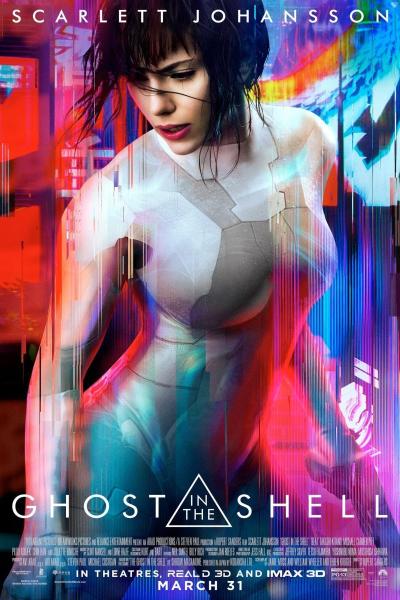
The Ghost in the Shell 2017 live action version's movie poster. Source: filmaffinity.com

Ghost in the Shell Live Action Film Review

The Ghost in the Shell 2017 live action film's poster. Source: filmaffinity.com

The Ghost in the Shell 2017 live action film’s poster.

I’m a big fan of Masamune Shirow (士郎 正宗),¹ particularly his seminal work Ghost in the Shell in all its incarnations (the original manga series and anime films, series, and OAV), so I was thrilled to hear that it would be getting a live action treatment. I know Scarlett Johansson is an excellent actress and adept at becoming different characters, so I wasn’t too worried about this casting choice. I eagerly rented the live action film from the iTunes Store and settled down to watch.

I almost quit within the first five minutes.

Shiro Masamune’s original plot has been significantly changed and dumbed down. Few of the changes I caught were necessary to convert Ghost in the Shell into a live action version (henceforth LAV). For starters, the LAV renames the main character and rewrites her history. In the original plot the protagonist’s name is Major Motoko Kusanagi (草薙 素子), who was the first person to receive a fully cybernetic body (i.e. only her brain remained organic) as a child. She grows up to join Section 9, “a counter-terrorist network and anti-crime unit operating in the Japanese National Public Safety Commission” ². In the LAV her name is changed to Major Mira Killian and she is often referred to as if “Major” is her name rather than her rank. She is nearly killed immigrating to Japan as an adult or near-adult in a terrorist attack that kills her parents. While she still becomes part of Section 9, she is beholden to the corporation (rather than government) which performed her experimental cyber transplant, creating the basis for part of the LAV’s plot—a plot that doesn’t exist in the original. Section 9 also appears to be a corporate security firm, or at least quasi-corporate, in the LAV rather than a government entity. These are just a few of the major, unnecessary changes that were made.

I don’t recall Shirow ever explicitly stating that Major Kusanagi has a “ghost” anywhere in the GITS canon. It’s implied. The LAV explicitly states this in the first few minutes of the film. I feel this translates into a massive dumbing-down of GITS’s themes and the warning it has for us. The producers appear to have made a calculation that dumbing-down GITS was necessary in order to bring a LAV to an American audience—the same Americans whose massive fanbase created the opportunity to make it. How insulting!

Speaking of insulting, other critics and fans have accused the LAV of whitewashing because the majority of the main characters aren’t Asian, let alone Japanese. Only two characters (not including extras) are played by Asians. The Hollywood Reporter invited four actresses of Japanese descent to comment on the film. Here’s just a portion of their reactions (first names and credits have been added for clarity:

Ai Yoshihara (The Sea of Trees): Major’s backstory is white people trying to justify the casting.

Atsuko Okatsuka (PULLproject Ensemble): And they f—ed up in the process because now it looks even worse. The text at the beginning of the movie explained that Hanka Robotics is making a being that’s the best of human and the best of robotics. For some reason, the best stuff they make happens to be white. Michael Pitt used to be Hideo.

Keiko Agena (Gilmore Girls): That was the other cringe-worthy moment, when they called each other by their Japanese names. We’re looking at these beautiful white bodies saying these Japanese names, and it hurt my heart a little bit.

Traci Kato-Kiriyama (co-founder of the all-Asian, mostly female Dis/orient/ed Comedy tour): It was supposed to be so touching and intimate, and it felt gross. And kind of laugh-worthy at the same time.

I couldn’t agree more. 

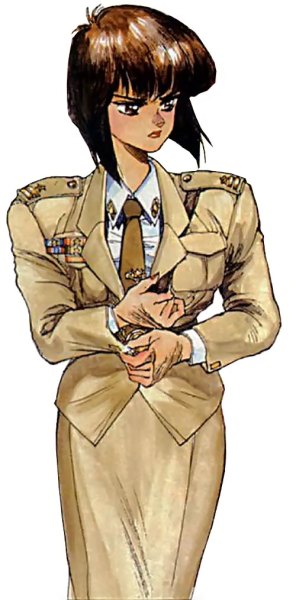
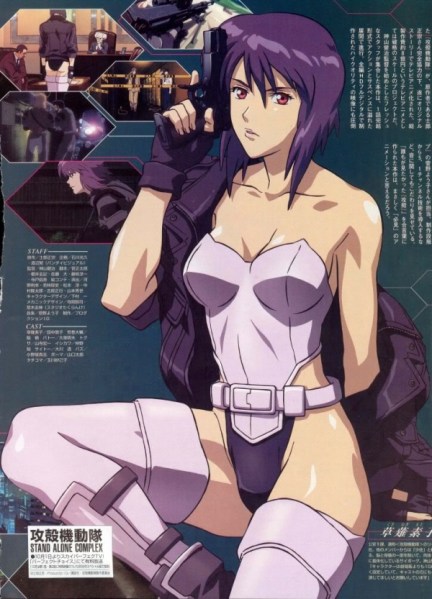
Surprisingly, Mamoru Oshii, director of the original anime, has stated he thinks casting Scarlett Johansson as Kusuanagi is perfect because “her physical form is an entirely assumed one. The name Motoko Kusanagi and her current body are not her original name and body, so there is no basis for saying that an Asian actor must portray her.”³  He’s right that the Major doesn’t appear to be a specific ethnicity in the anime. But the same is true of many anime characters. More damningly, in the manga Kusanagi is depicted with dark, typically Asian-looking hair and slanted eyes, as shown on the right. Oshii also states that GITS is set in future Hong Kong, which the LAV creators said they respected, and which is dead wrong. As the Wikipedia article states, the GITS franchise is “primarily set in the mid-twenty-first century in the fictional Japanese city of Niihama, Niihama Prefecture (新浜県新浜市 Niihama-ken Niihama-shi), otherwise known as New Port City (ニューポートシティ Nyū Pōto Shiti)”.

Even in the anime, her eyes appear to be Asian, directly undercutting Oshii’s argument. It’s entirely reasonable to believe that Kusanagi’s cyborg body was designed to look Asian, especially once you take into account the ethnic homogeneity preferred by Asian cultures. And in the LAV (spoiler alert), she turns out to be Japanese after all!

The LAV also makes other odd choices. Though its setting is future Hong Kong, the background chatter is Japanese rather than Chinese or the mishmash of Chinese and Japanese spoken by Hong Kong natives. Adding to the confusion, the chief of Section 9, Daisuke Aramaki (荒巻 大輔), speaks Japanese throughout the LAV. (Very poorly enunciated and thus difficult to understand Japanese.) I’m usually all for subtitling rather than changing the language, but the language wasn’t appropriate for the setting (unless we’re to understand that Japan has taken over Hong Kong again, in which case, why not just set it in Japan? The canon is set in Japan anyway!), it was difficult to keep switching between Japanese and English comprehension, and the subtitles were inaccurate.

More mysteries are in the iconic scene where Kusanagi drops from the roof to crash the business meeting. First, the LAV takes two different scenes from the canon—the roof drop and the hacked geisha taking over the official’s cyber brain—and mashes them into one. Secondly, in the canon Kusanagi uses a bungee or rappel cord to anchor her descent. In the LAV she appears to free fall without any safety device. As she falls in the canon, her camouflage renders her invisible. In the LAV she remains visible until the film cuts to inside the teahouse.

This brings me to costuming and the presentation of Kusanagi’s body. The LAV made the odd choice to make the Major’s body armor nearly white (it’s charcoal in the canon). It also looks more like a leotard than functional armor. From what I saw (about half the film), Johansson doesn’t appear to wear either Kusanagi’s formal uniform (see above right for an example from the manga) or her default “corset and thong” outfit (see above left for an example from the anime). The omission of Kusanagi’s sexy default outfit may be an attempt to downplay her sexuality. The decision to not make Johansson’s bust size match the character’s—there appears to be a three- to four-cup-size difference—likewise desexualized her. In the scene where Killian (remember her name was changed for the LAV)  is being repaired after getting blown up, her bust appears almost flat. This scene is also interesting because the framing and the way in which Killian’s body is depicted fits neatly into feminist criticism of the way the media often slices women into sexualized parts.

Obviously there’s a lot to criticize in the LAV. I hope Netflix does a better job with the live action version of Death Note it’s announced, but have strong doubts. (By the way, “A Netflix Original Film” [emphasis mine]? I don’t think so!)

THE BOTTOM LINE: A smiling pile of poo A smiling pile of poo A smiling pile of poo A smiling pile of poo A smiling pile of poo
I give this film five steaming piles of poo. Even the computer graphics eye-candy cannot save this one. Fans should avoid and protest the whitewashing loudly.


¹ Japanese names are Anglicized (Given Name followed by Surname) to maintain consistency within this post.

² “Public Security Section 9.” Wikipedia. August 05, 2017. Accessed August 30, 2017. https://en.wikipedia.org/wiki/Public_Security_Section_9.

³ Rose, Steve. “Ghost in the Shell’s whitewashing: does Hollywood have an Asian problem?” The Guardian. March 31, 2017. Accessed August 29, 2017. https://www.theguardian.com/film/2017/mar/31/ghost-in-the-shells-whitewashing-does-hollywood-have-an-asian-problem.

 “Ghost in the Shell.” Wikipedia. August 28, 2017. Accessed August 30, 2017. https://en.wikipedia.org/wiki/Ghost_in_the_Shell#Setting.

 Shelton, William. “Doing Sexy Right: A Look at Ghost in the Shell’s Major Motoko Kusanagi.” Poor Mans Geek. September 27, 2015. Accessed August 29, 2017. https://poormansgeek.wordpress.com/2015/09/27/doing-sexy-right-a-look-at-ghost-in-the-shells-major-motoko-kusanagi/.