Today we finished listening to part three of Braiding Sweetgrass by Robin Wall Kimmerer for our friend AdventuRyn’s Botany Book Club. (Join the fun live on Twitch at 4:00 PM Pacific every Monday!) We were really struck by the last essay in this section, “The Honorable Harvest”. In this essay Kimmerer explores what it means to harvest honorably, from ancient indigenous traditions to the aisles of today’s supermarkets. The keys are respect and reciprocity. At the end of the essay she talks about going shopping for pens and how she is unable to honorably harvest them because “everything [in the store] is dead.”
This immediately made us think about books because while many consider them to be dead objects, we firmly believe that each book has a soul. Many Native American peoples believe that stories are alive because they come to life as they are told by the storyteller. We don’t know if they would also regard books as alive, but we do. Stories come to life through their pages or via the audiobook narrator.
If books are alive, then they also deserve to be treated with respect and reciprocity. How can we practice honorable harvesting when we read?
Our answer is by taking our time. We show respect by paying careful attention. We do not rush. We do not cram tales in our mouth like Cookie Monster with a plate of cookies. We take time to savor them. To let each one into our heart and mind. To reciprocate by thinking about and discussing them. And finally, we pay the gift forward by recommending them to others who will cherish them.
Advertising disclosure: As an Amazon affiliate, we earn a commission on qualifying purchases. You can also support local bookstores and our book habit via our store on Bookshop.org.
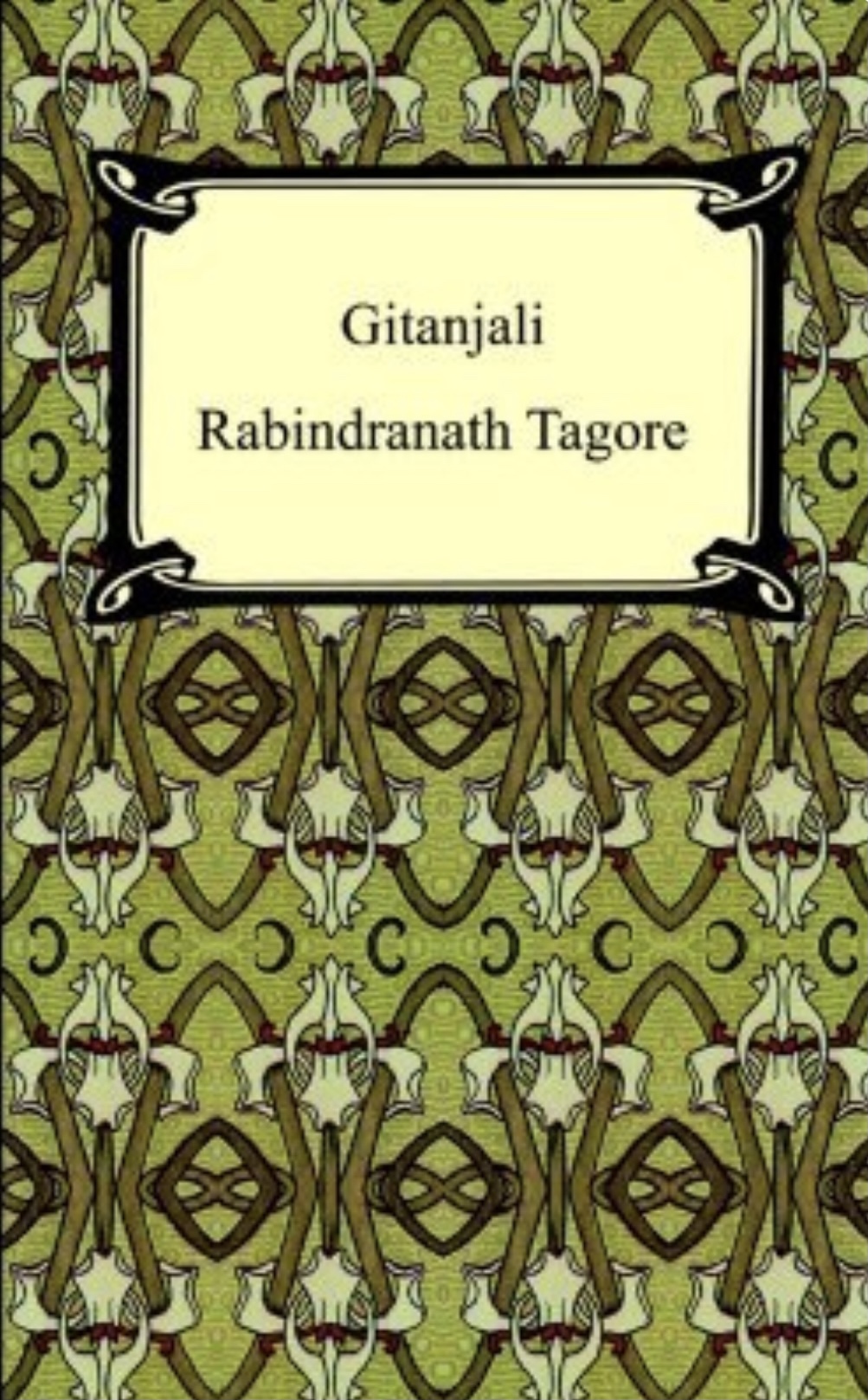
Gitanjali is a collection of poems by Bengali poet Rabindranath Tagore. It was first published in 1913 and is one of his best known works, for which he earned the Nobel Prize in Literature. We read the English translation. We aren’t clear whether it was translated by W.B. Yeats, or Yeats had it translated, but it is clear from his introduction that Yeats greatly admired Tagore’s work. Since we have enjoyed Yeats, we were intrigued.
We had never heard of Rabindranath Tagore before. We discovered Gitanjali when we were looking for a book that would fulfill The StoryGraph’s 2021 Genre Challenge’s “Read a poetry collection under 100 pages” prompt. Happily, we could also use this book to fulfill prompts for The StoryGraph’s 2021 Translation Challenge and as a bonus read for ReadWithCindy’s 2021 Asian Readathon. (If you decide to participate in reading challenges, we suggest doubling up on prompts as much as possible.)
Since Gitanjali is now in the public domain, you can find it for free online. We happened to find the copy we read on spiritualbee.com. The website also has several of Rabindranath Tagore’s other works and they recommend you read his prose first so you can better appreciate his poetry. Good advice we cheerfully ignored.
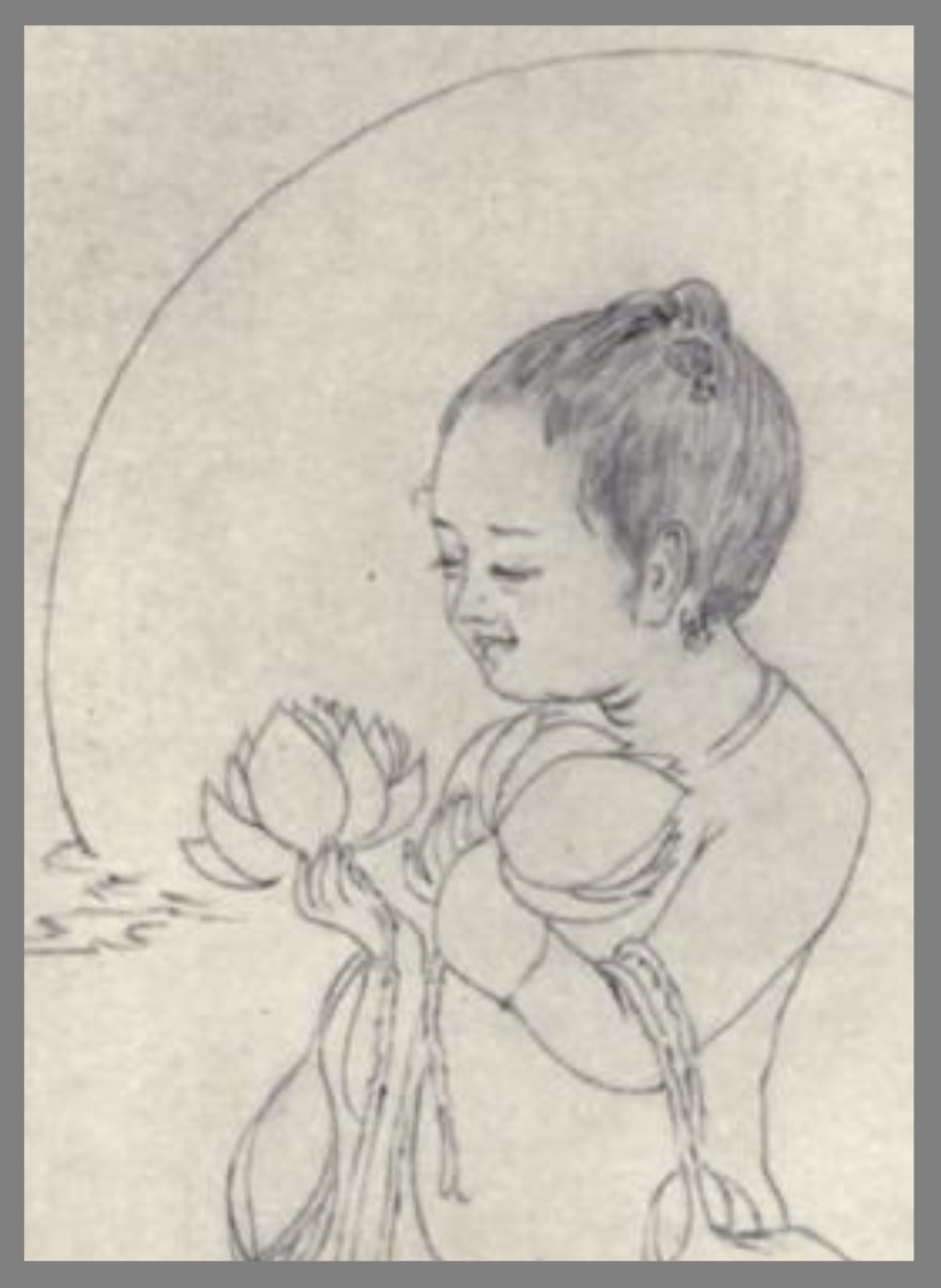
One of the things we enjoyed about this edition were the included illustrations, like this drawing by Asit Kumar Haldar, which accompanies one of our favorite poems in the collection, number 96 or “When I go from hence let this be my parting word”.
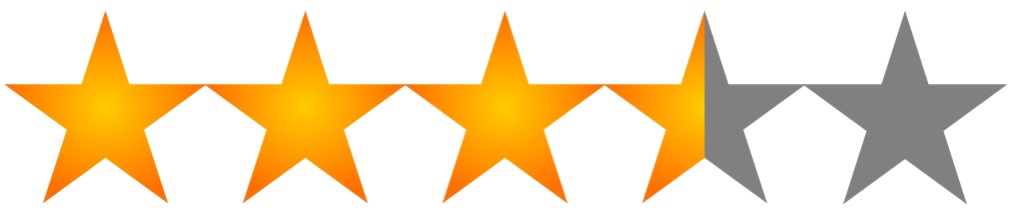
We ended up rating Gitanjali three out of five stars. Most of it is deeply spiritual poetry which addresses the author’s relationship with God, and as we do not share his faith, and perhaps also because we do not know the allusions to his prose work, it did not speak to us. The format also makes it difficult to tell whether each poem is supposed to stand alone or is a continuation of the previous poem. But there are still several gems in the collection that speak to universal themes of joy, oneness with the universe, and human nature.
Poem number 30 made us laugh:
I CAME out alone on my way to my tryst. But who is this that follows me in the silent dark?
I move aside to avoid his presence but I escape him not.
He makes the dust rise from the earth with his swagger; he adds his loud voice to every word that I utter.
He is my own little self, my lord, he knows no shame; but I am ashamed to come to thy door in his company.
Rabindranath Tagore, Gitanjali, poem no. 30
Who hasn’t experienced this? Perhaps last time we were in our friends company we were arrogant and boastful or couldn’t help lashing out in anger and despair.Now we come to our friend sheepishly, hoping they will still embrace us despite the dumbass things we did.
There were also poems that gave us goosebumps from sheer brilliance. One of these was poem number 74:
THE day is no more, the shadow is upon the earth. It is time that I go to the stream to fill my pitcher.
The evening air is eager with the sad music of the water. Ah, it calls me out into the dusk. In the lonely lane there is no passer by, the wind is up, the ripples are rampant in the river.
I know not if I shall come back home. I know not whom I shall chance to meet. There at the fording in the little boat the unknown man plays upon his lute.
Rabindranath Tagore, Gitanjali, poem no. 74
This poem gives a feeling of ineffable sadness, but also beauty, and makes us think of Swan Lake’s haunting refrain. We can easily envision the dusk closing in on this nearly deserted shore. Even the lute player has a sense of ghostly liminality. It is the sort of scene where worlds meet and tales begin.
So if you enjoy poetry, are looking to expand your knowledge of Bengali writers, or both we encourage you to read this small poetry collection for the few gems that might sparkle as brightly for you.
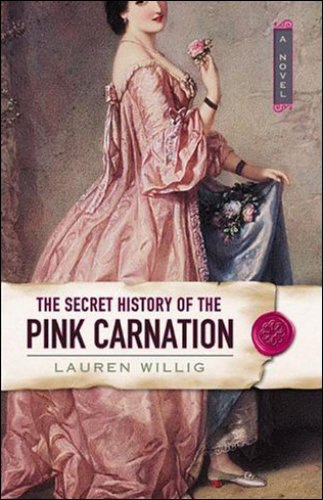
Deciding that true romantic heroes are a thing of the past, Eloise Kelly, an intelligent American who always manages to wear her Jimmy Choo suede boots on the day it rains, leaves Harvard’s Widener Library bound for England to finish her dissertation on the dashing pair of spies the Scarlet Pimpernel and the Purple Gentian. What she discovers is something the finest historians have missed: a secret history that begins with a letter dated 1803. Eloise has found the secret history of the Pink Carnation the most elusive spy of all time, the spy who single-handedly saved England from Napoleon’s invasion.
The Secret History of the Pink Carnation, a wildly imaginative and highly adventurous debut, opens with the story of a modern-day heroine but soon becomes a book within a book. Eloise Kelly settles in to read the secret history hoping to unmask the Pink Carnation’s identity, but before she can make this discovery, she uncovers a passionate romance within the pages of the secret history that almost threw off the course of world events. How did the Pink Carnation save England? What became of the Scarlet Pimpernel and the Purple Gentian? And will Eloise Kelly find a hero of her own?
Why You Should Listen
~Because Book~
This book has survived several relistens over the years. Eloise Kelly makes a very likable narrator and we find her thesis-researching travails easy to identify with. It’s through Eloise we’re introduced to Amy, our Regency heroine and would-be member of the League of the Purple Gentian. The author sets up nice parallels between the modern and historical romantic action. This device does tend to highlight the plot’s predictability—and formulaic plots are something the series suffers from as you read other installments—but we’re not here for an original plot.
We’re here for the characters and the humor that keeps us laughing out loud. The banter is spot-on in a dry, tongue in cheek flavor that hits our sweet spot. The characters may do absolutely stupid things, but they get roasted for it, often by themselves. Our favorite characters are actually the chaperone, Miss Gwen, and Amy’s sensible cousin, Jane. They provide balance and keep the book from veering into utterly ridiculous territory. If you love Amelia Peabody and Alexia Tarabotti, you’ll love Miss Gwen.
As far as we can tell, the historical accuracy is spot-on, too. Author Lauren Willig makes Napoleon’s France come to life. She uses a wealth of detail to make her characters seem as if they must have really existed—and who wouldn’t want such dashing spies to be real?
~Because Narrator~
Kate Reading narrates with a lovely contralto. Most of the time her performance allows you to forget the book is being read to you, which is great! She’s able to differentiate the characters’ voices and switch among genders and ages with ease. At times, her renditions, while true to character, get a bit stridently high-pitched for our taste, especially in Amy’s impassioned moments. So this audiobook is not really a good choice if you’re looking for a story to nod off to (though the content is often exciting enough to keep you awake on its own). We also found some of her French accents grating, but since she also performs some superbly (to our American ears, at least), we assume she exaggerated for comedic effect. Obviously, none of this has kept us from listening time and time again.
A Word to the Wise (Content Warnings)
Major: Detailed sex scenes
Moderate: Sexism and misogyny appropriate to the period (usually counterbalanced by feminine subversion), attempted sexual assault, violence, heteronormativity
Minor: Brief mention of blood and torture
TL;DR
The Secret History of the Pink Carnation is a great listen if you’re in the mood for a funny, lighthearted, adventure with dashing spies and girl power, as long as you don’t mind the predictable romance aspects. The characters’ witty repartee will keep you coming back for more. Good narration, but not for bedtime listening.
We recently discovered The StoryGraph thanks to ReadWithCindy’s 2021 Asian Readathon (check out our picks here). According to the website, “The StoryGraph helps you track your reading and choose your next book based on your mood and your favorite topics and themes.” Intrigued, we decided to take it for a test drive.
A Few Caveats
We’ve only checked out The StoryGraph on our iPhone, so keep in mind that the desktop version may have features we didn’t get to experience. But let’s be honest, all major features should work on all versions of a site, especially when users can’t opt to switch to desktop mode. If we can’t do it on our iPhone, it might as well not exist. 😆
It’s also important to note the site is still in beta mode and actively adding new features while troubleshooting existing ones. The StoryGraph seems very responsive to user demand and it’s fair to expect many of the limitations we experienced will be temporary.
The StoryGraph Difference: Things to Love
The StoryGraph’s UI is clean and minimalist. We appreciate the calming, uncluttered vibe. It does lack a dark mode, though, so photosensitive viewers may want to use a dark reader. Sign up is quick, easy, and doesn’t ask for sensitive information. We haven’t been spammed since we signed up, either! The StoryGraph can import your Goodreads library for you, but we decided to start with a fresh slate.
Let’s talk about how The StoryGraph stands out from the crowd. Two things are at the heart of the StoryGraph experience: moods and statistics.
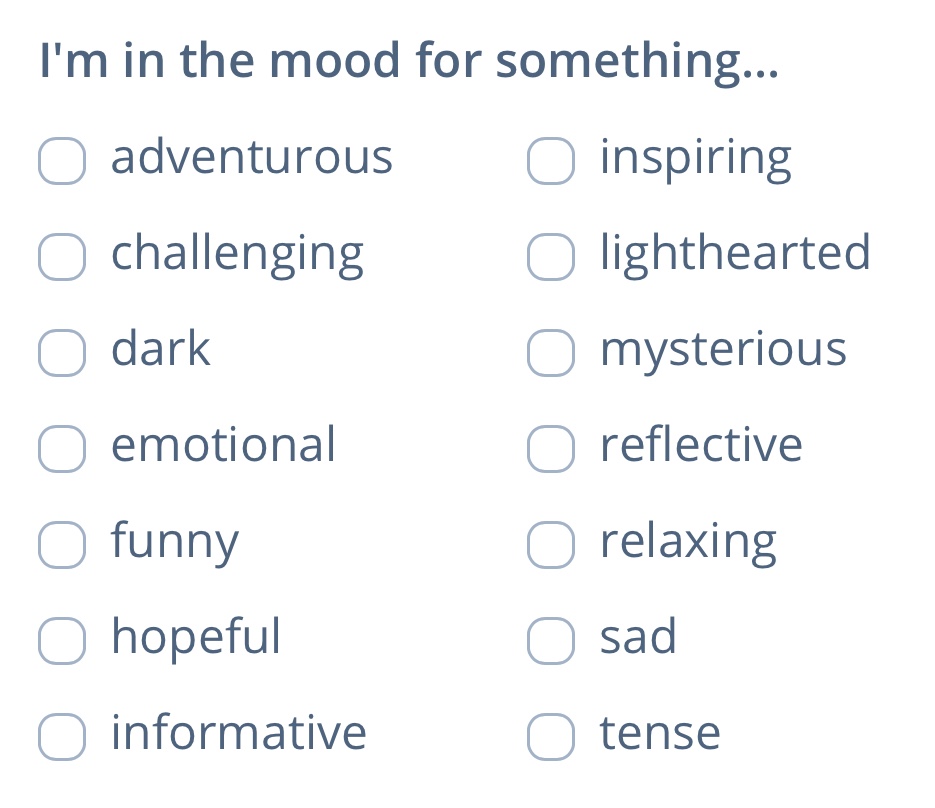
The StoryGraph’s tagline is “Because life’s too short to read a book you’re not in the mood for.” Thus, books are primarily judged on feels. In addition to the mood list to the right, readers can indicate a book’s pace, length, whether it’s plot- or character-driven, and even content warnings. These are great metrics for deciding whether a book is a good fit for you. We’d like a few more mood options, but the current set covers a lot of ground.
We’re especially excited about the ability to flag content warnings! This is extremely useful. You can note whether potentially triggering material is major, moderate, or mild. We would like the ability to do this if we haven’t finished a book, though. What if the material was so triggering we had to stop reading? That’s important information for others to know without having to check out the written review. It should be part of the aggregate data. It also needs to be easier to add content warnings to the menu. The StoryGraph figures this is covered by tags, but as far as we can tell, tags are useless. The tagging function might as well not exist.
Of course, you can rate books you’ve read out of 5 stars, but The StoryGraph lets you do so to a quarter-star level of granularity! You can also add a written review and include links.
The StoryGraph takes all the data you’ve given it about what kind of books you enjoy and generates a reader profile. Even with little to go on, it had us pretty well pegged from the get-go.
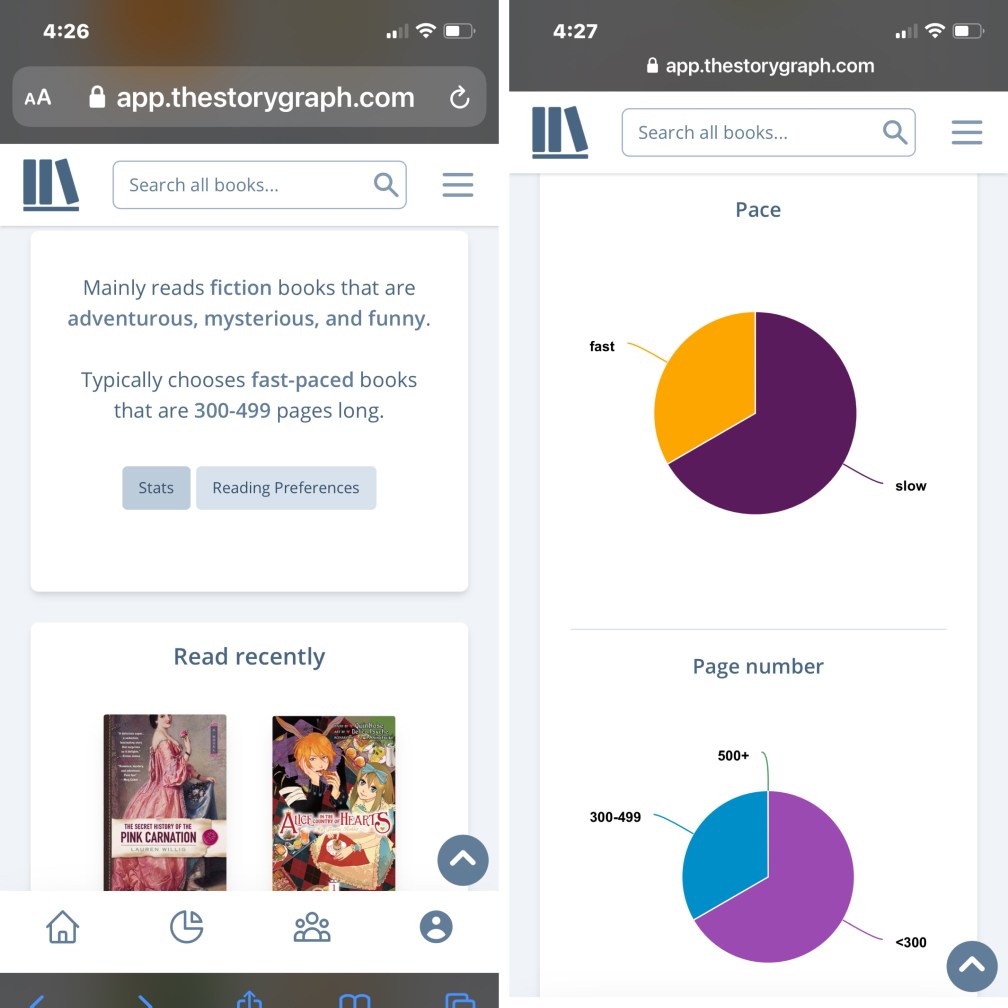
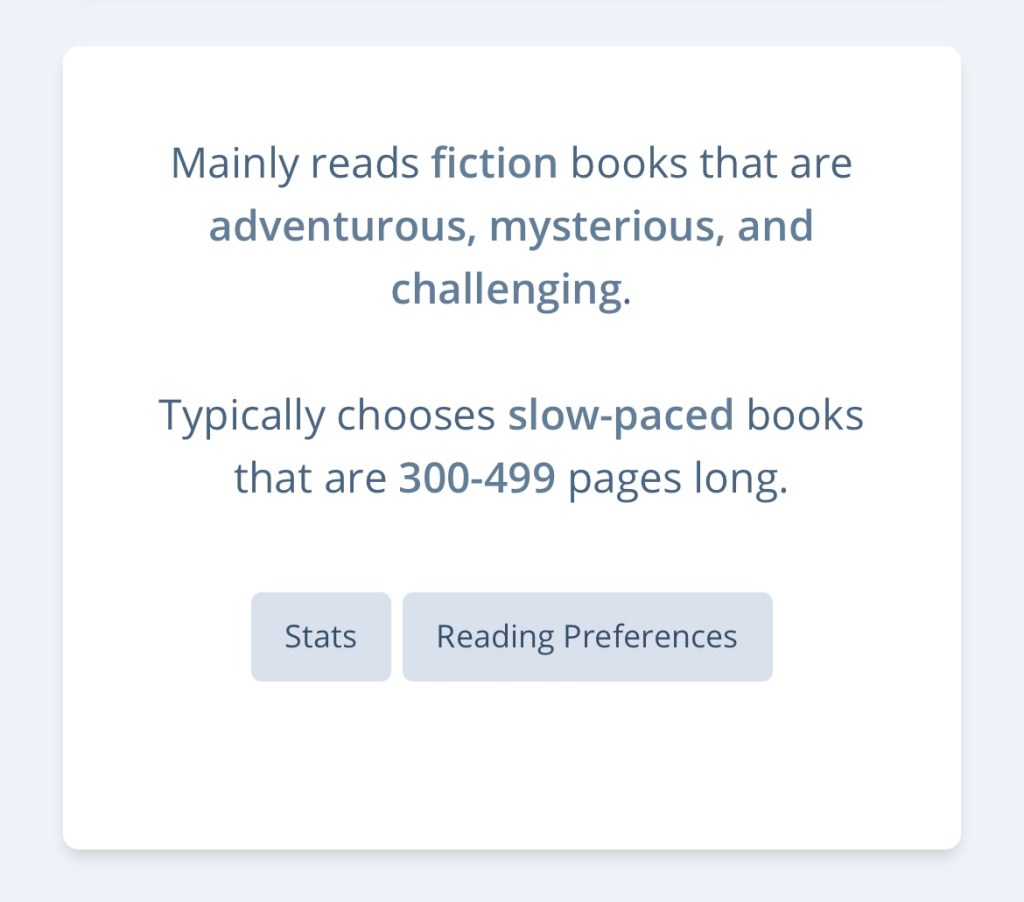
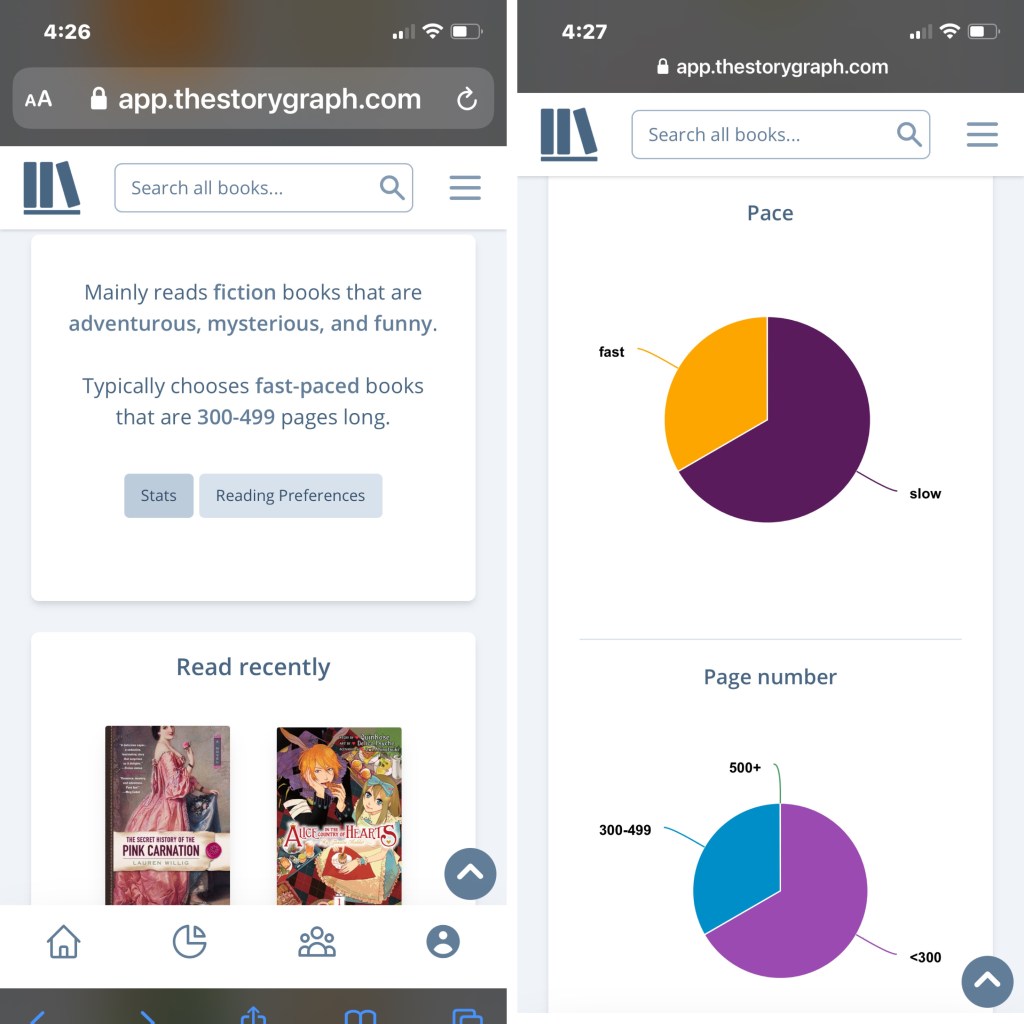
This assessment gets more accurate the more you fill out your The StoryGraph library. Ours changed from the initial, “Mainly Reads fiction books that are adventurous, mysterious, and challenging. Typically chooses slow-paced books that are 300-499 pages long,” to adventurous, mysterious, funny, and fast-paced. The StoryGraph uses this profile to generate recommendations—which are pretty good—and pretty graphs of your reading stats. Unfortunately, there is a lag between updating the profile and the graphs, which can result in confusing mismatches like the one shown below.
Which is correct? In these screenshots, taken just a few seconds apart, our reader profile says we typically choose fast-paced books that are 300-499 pages long, but our stats say we typically choose slow-paced books under 300 pages.
The graphs are fun, though, and the way they crunch the days really does make it easier to find books you’ll love. The StoryGraph also sidesteps the Goodreads toxicity simply by not having a social media aspect. The only way to interact with others on the site is to follow them or join a reading challenge. Even so, it’s at a remove. “This is what I read and what I thought. The end.” It’s rather refreshing and adds to the chill vibe.
We’ve found the biggest reason to stay active on The StoryGraph are the reading challenges. These are a fun way to stretch your reading horizons. When you challenge yourself to read books that fit theprompts, you’ll find yourself adding new authors and genres to your TBR pile! It’s also easy to create your own reading challenges and you can keep them to yourself, share privately with friends, or make them public so anyone can join.
What Needs Work
Navigation overall is clunky. For example, if you use the reading journal feature to jot down a note about your reading and then save it, there is no button to add another entry on the resulting screen. You have to go back to the book’s page and press “track progress” and then “add note”.
It’s easy to search for and add books by title or author using the main search bar. Key word: or. As of this writing, you can’t do both. You cannot filter those results or search for tags. You can only filter results from the “Browse all books” search. As power searchers, we hate this with the same passion we hated Google doing away with Boolean operators. You can’t use the main search bar to find other users or reading challenges, either. That has to be done in their respective sections. Searching by ISBN doesn’t work, unless you’re in the “add a book/edition” dialogs (which, while we’re on the subject, aren’t user-friendly—and we say this with librarian training). The StoryGraph’s selection is mostly English titles that are currently in print. The site also isn’t set up to track journals and periodicals. We want to be able to search for anything using the main search bar, or at least have an advanced search mode that does that. If we have a physical copy, we also want to be able to use our phone camera to “scan” the barcode.
What would’ve been really useful would’ve been a way to import our Audible library and listening history. Unfortunately, The StoryGraph, like all the other reading sites out there, doesn’t cater to audiobook lovers. Their form for manually adding other editions makes it look like they are planning to correct this, since you can manually add an audiobook edition and input length in hours and minutes. We have yet to see an audiobook edition on The StoryGraph “in the wild”, though, probably because you have to add it yourself—a pain in the ass most users won’t have time for.
Even if you do add an audiobook edition, you can only track your reading progress by percentage read. That means we have to look at the progress bar in our audio player and guesstimate. The site should be able to do the math for you; just put in the hours and minutes you’ve listened so far and—lo!—a progress bar appears! But no, they want you to do division in base 60. Hopefully addressing these issues is in the works. We think it would help The StoryGraph stand out as a welcoming site for neurodivergent and disabled readers.
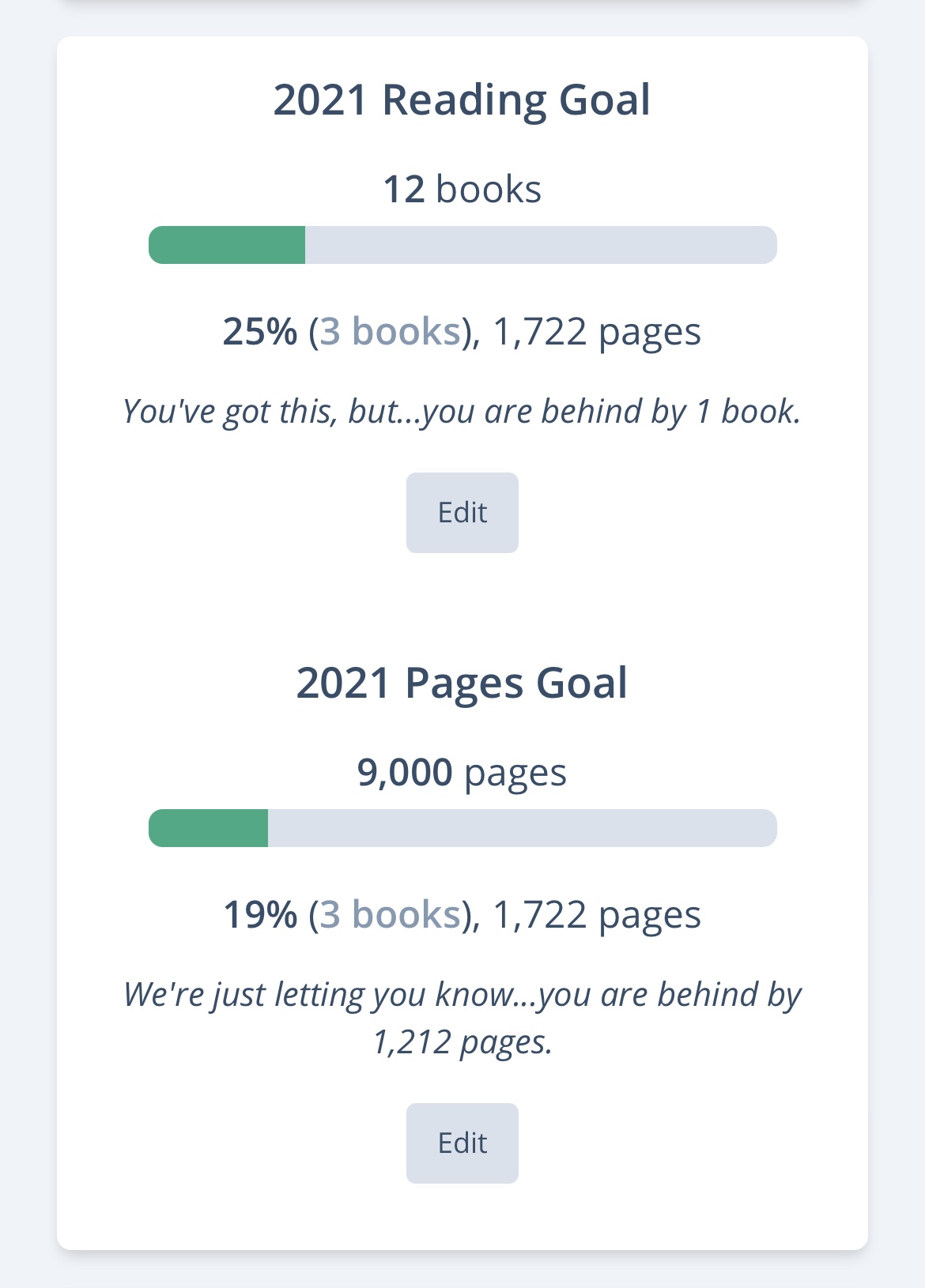
Our final complaint is that whoever designed the books and pages read goals is a sadistic bastard. We are here for fun. We really do not need the site to push our anxiety buttons by telling us we’re behind. Once we took a screenshot for this review, we deleted our goals for our mental health.
TL;DR:
Being able to find books based on what you’re in the mood for is fabulous!
Content Warnings! SO USEFUL! It needs to be easier to add CWs that aren’t on the list yet, though.
Reading challenges are what keep us coming back. They’re great fun!
Reader profiles, and thus recommendations, are very good with only limited data, which does the strength of their algorithms.
The site looks pretty and soothing, but needs a dark mode.
Love the lack of social media features! Makes it a chill, nontoxic environment.
Navigation is clunky and less-prominent features are hard to use.
Tags are pretty much useless. The function might as well not exist.
As much as we love ye olde paper books, The StoryGraph needs to get with the times and support audiobook and ebook readers.
Whoever designed the books and pages read progress reporting is a sadistic bastard. We do not recommend anyone with anxiety, perfectionism, or workaholism issues use this feature.
Most of the flaws are probably due to The StoryGraph being fairly new and primarily relying on librarian volunteers. Hopefully they’ll improve if the site continues to grow and gain traction.
Final Thoughts
We think we will be sticking with The StoryGraph for a while and encourage you to check it out for yourself if you haven’t yet! We look forward to the site growing into its shoes, so to speak, and are thrilled to have a site where we can share our love of books without getting overwhelmed by the social aspect.
We’re not saying being woke is a bad thing, but it stinks when you suddenly can’t stand books or authors you used to enjoy. We read to escape, darn it, and here comes our sociopolitical awareness jolting us out of a nice fantasy. So rude!
This has been happening a lot with romance novels lately. Romance novels are the epitome of escapism. No other section in the book store offers quite the same level of pure fun—and we say that as card-carrying SFF and manga buffs. Sci-fi, fantasy, and comics—at least the kind we enjoy—all ask you to think on some level. Even fantasy romps like Piers Anthony’s Xanth series have a cleverly concealed commentary on society. So does Ranma 1/2. Marvel and DC’s comics do, too.
Romance novels, on the other hand, usually conform very closely to social norms. They uphold the “one true love” ideal and a whole bunch of other nonsense.
Case in point: we were listening to Selkies are a Girl’s Best Friend by Molly Harper. (No, that is not our typo. That’s the published title. Shame on whoever edited it!) Molly Harper is good with the snark and we were looking forward to another laugh out loud installment. And then the main character, Sophia, has an inner monologue in which she submits to societal pressure to settle down and have kids with a guy she has only known for a few days and initially hated. Cue our inner monologue saying, “This is ridiculous and unhealthy. We’re returning this book.”
We’ve also been listening to Ravenheart by Dannika Dark, the second novel in the Crossbreed series. This series is more action murder mystery in an urban fantasy setting than romance and it’s also full of snark. At one point our heroine Raven goes on a date with Detective Glass. Glass insists on ordering for her and overrules her saying she’d prefer a chicken salad. At which point we’re wondering why she doesn’t get up and leave. After the date Raven’s internal monologue is all about how she liked Glass being dominant (we’d call that being a domineering asshole). This is way out of character for Raven, who we expected was only dating Glass to get close to the investigation and piss off her work partner Sebastian. But it does support toxic social norms around masculinity and romance. We’re not sure yet if this is a blip in an otherwise enjoyable series.
We are wondering if outgrowing romance novels is a mark of emotional maturity, of being ready to set those toxic norms behind us.
I really enjoy audiobooks. Over the last few years I’ve read more books using my ears than my eyes! But audiobooks are tricky critters.
An audiobook makes you pay attention to every word. There’s no skimming long pastoral sections to get to the action. This can either make you appreciate hidden gems in these sections, or underline a writer’s weakness. We do need description, world-building, and character backgrounds, but it takes skill to smoothly incorporate these into a narrative without bogging it down. Whenever I listen to Katherine Kerr’s Deverry series, I find clever elements I’d overlooked in print.
Stories also have a rhythm to them. There are down or quiet moments in between the heart-hammering up scenes. Many writers are weaker in one of these tempos and audiobooks bring this out.
For example, while I wouldn’t say that Robert Jordan is necessarily weaker in one tempo, I did notice that The Eye of the World’s rhythm matched The Lord of the Rings’ almost point for point. This was so distracting, I couldn’t enjoy the story.
These are just a couple of the reasons it’s a good idea to record your completed draft and listen to it. What eludes you on the page will jump out at you on audio.
Once you have a polished tale, audiobooks can still play you false.
Professional editors will tell you it’s better to just use “said” in dialogue, especially lengthy dialogue. They reason that it’s easier on the reader because said fades into the background. But if you’re an audiobook reader, a lot of “said”s in a short span is repetitive and grates on the ears. At least on my ears. 🙂 I vastly prefer writers with a more varied approach to dialogue.
The voice actor who reads your work is important as well. And authors generally have no say in the casting process unless they’re reading themselves. For example, I recently listened to American Gods by Neil Gaiman on CD. A friend had recommended the TV show to me and I didn’t like it. I decided to see if the book was better (it definitely was!). I’m not sure I got the full impact of it, though. The reader’s voice had this Lake Wobegone quality to it that sucked all the extremes out of the narrative. The result was rather ho-hum. And ho-hum is generally the last word people use for Neil Gaiman’s writing.
Audiobook companies are also notorious for switching narrators in the middle of a series. Occasionally this is a good thing because the first reader was dreadful. Most of the time it gets the readers up in arms. We’ve grown accustomed to associating a certain voice with the series and its characters. It’s really jarring to change that and throws most readers right out of the story.
In a recent example, Lorelei King has read all of Patricia Briggs’ Mercy Thompson series until the most recent addition, Silence Fallen. In Silence Fallen Lorelei King still reads the chapters from Mercy’s point of view, but a male narrator now reads chapters from Adam’s point of view. I didn’t like it, but had finally started to get used to it when, for example, the female narrator would pop in to the male section to let us know time was passing differently for each character. That was so jarring! I honestly don’t know why audiobook companies persist in doing this kind of thing.
To sum up, I think it’s wise for writers to keep the audio version in mind. And maybe insist on casting control in your contract. 😉
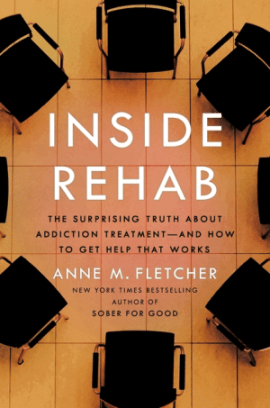
I started reading Inside Rehab by Anne M. Fletcher and was surprised to learn that “the word ‘addiction’ comes from a Roman law having to do with ‘surrender to a master'” (11). I checked the OED and learned it’s derived from the Latin a dicere, which means one who is dictated to.
There’s debate in psychology circles about whether someone can be addicted to a person. I’ve always held that the answer is yes from personal experience. It looks like this was an original sense of the word.
Another sense of the original Latin tells us that one can be addicted to anyone or anything which dictates one’s actions. This supports the experience of many people from abusive relationship or cult survivors to Internet porn or social media addicts.
I call this debate settled.
Fletcher, Anne M. Inside rehab: the surprising truth about addiction treatment: and how to get help that works. NY, NY: Viking, 2013.
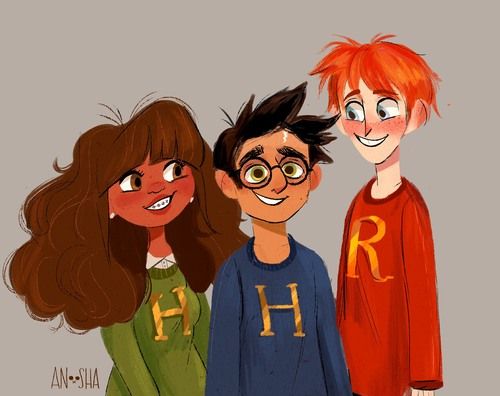
Anoosha Syed’s black Hermione is super cute! But, alas, confusing.
First, I’d like to say that writing a diverse cast of characters with regard to ethnicity, sexuality, gender identity, and so on without making it the focus or raison d’être is one of my goals. I’ve run into some problems because I’m untangling racism I didn’t realize I’d imbibed growing up and because it can be difficult to write the other, let’s be real. I’ve had to realize that you can’t please everybody and I just have to do my best to navigate these issues.
Now, Anoosha Syed argues that J. K. Rowling never states what race Hermione Granger is in the books. The closest she comes is one line in The Prisoner of Azkaban in which her skin is described as brown. So it’s not surprising that readers of all ethnicities would assume that she was their ethnicity. When done consciously, this process is called disidentification. When unconsciously, it’s called ethnocentrism. Syed further argues that Rowling selected a black woman, Noma Dumezweni, to play Hermione in the stage version. The author also retweeted her fan art, giving it the seal of approval.
Noma Dumezweni as Hermione Granger.
Emma Watson as Hermione Granger.
Rowling’s actions are legitimately confusing for fans. She also selected Emma Watson, a white girl, to star in the film versions. Much was made of Rowling’s power to ensure accuracy in the films. And yet I’ve always been bothered by many inaccuracies that weren’t demanded by changing the medium. For example, in the books all of the Dursleys are clearly described multiple times as blond. Yet in the films they are brunettes. If the actors playing the Dursleys were the best available for the parts, hair dye or wigs could have easily fixed this problem.
So does Rowling herself not have a clear vision of what her characters look like? Does she just not care? Is she content to have multiple versions of her characters?
In a June 5, 2016 interview with The Guardian she says, “It was 17 years and just because I’ve stopped on the page doesn’t mean my imagination stopped.” So if the world of Harry Potter is still vivid in her mind, which casting choice better reflects her imagination?
In the same interview, Rowling addressed the controversy directly. “I decided not to get too agitated about it and simply state quite firmly that Hermione can be a black woman with my absolute blessing and enthusiasm,” she said.
“Can be a black woman.” (Emphasis mine.)
This wording suggests that Hermione was not originally a black woman in Rowling’s imagination, just that she’s okay with her character being portrayed as multiple races. She does not definitively state what ethnicity she had in mind when she wrote the Harry Potter series. So with the evidence at hand, I must conclude that Emma Watson best reflects Rowling’s vision. Watson was cast first and Rowling insisted the film accurately portrayed the books.
I understand Rowling’s impulse to embrace a more multicultural version of her characters. In essence, she is rewriting the Harry Potter series with her choices. And perhaps she didn’t have as much control over the films and play as purported. We’ll never really know. But I think a better and less confusing choice would have been acknowledging a black Hermione is a brilliant idea she wished she’d thought of, and then working to write with a wider color palette.






 Honeycomb's Hive