
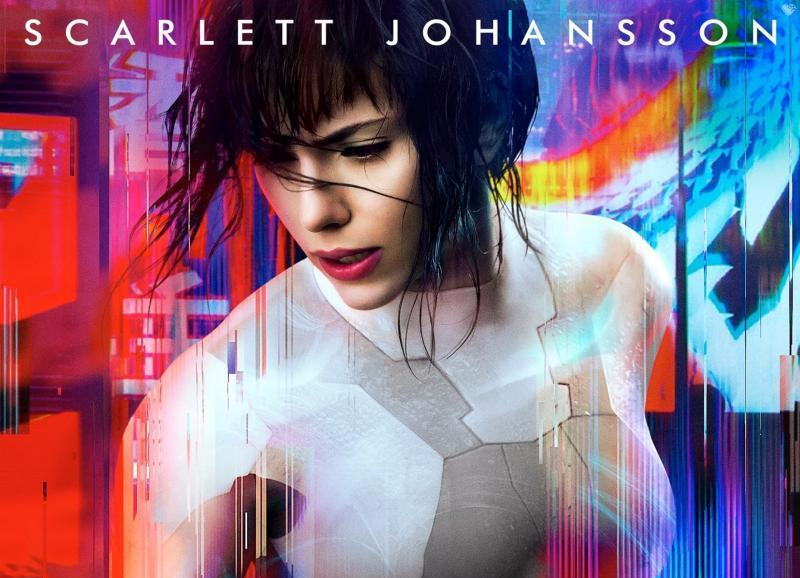
The Ghost in the Shell 2017 live action film’s poster.
I’m a big fan of Masamune Shirow (士郎 正宗),¹ particularly his seminal work Ghost in the Shell in all its incarnations (the original manga series and anime films, series, and OAV), so I was thrilled to hear that it would be getting a live action treatment. I know Scarlett Johansson is an excellent actress and adept at becoming different characters, so I wasn’t too worried about this casting choice. I eagerly rented the live action film from the iTunes Store and settled down to watch.
I almost quit within the first five minutes.
Shiro Masamune’s original plot has been significantly changed and dumbed down. Few of the changes I caught were necessary to convert Ghost in the Shell into a live action version (henceforth LAV). For starters, the LAV renames the main character and rewrites her history. In the original plot the protagonist’s name is Major Motoko Kusanagi (草薙 素子), who was the first person to receive a fully cybernetic body (i.e. only her brain remained organic) as a child. She grows up to join Section 9, “a counter-terrorist network and anti-crime unit operating in the Japanese National Public Safety Commission” ². In the LAV her name is changed to Major Mira Killian and she is often referred to as if “Major” is her name rather than her rank. She is nearly killed immigrating to Japan as an adult or near-adult in a terrorist attack that kills her parents. While she still becomes part of Section 9, she is beholden to the corporation (rather than government) which performed her experimental cyber transplant, creating the basis for part of the LAV’s plot—a plot that doesn’t exist in the original. Section 9 also appears to be a corporate security firm, or at least quasi-corporate, in the LAV rather than a government entity. These are just a few of the major, unnecessary changes that were made.
I don’t recall Shirow ever explicitly stating that Major Kusanagi has a “ghost” anywhere in the GITS canon. It’s implied. The LAV explicitly states this in the first few minutes of the film. I feel this translates into a massive dumbing-down of GITS’s themes and the warning it has for us. The producers appear to have made a calculation that dumbing-down GITS was necessary in order to bring a LAV to an American audience—the same Americans whose massive fanbase created the opportunity to make it. How insulting!
Speaking of insulting, other critics and fans have accused the LAV of whitewashing because the majority of the main characters aren’t Asian, let alone Japanese. Only two characters (not including extras) are played by Asians. The Hollywood Reporter invited four actresses of Japanese descent to comment on the film. Here’s just a portion of their reactions (first names and credits have been added for clarity:
Ai Yoshihara (The Sea of Trees): Major’s backstory is white people trying to justify the casting.
Atsuko Okatsuka (PULLproject Ensemble): And they f—ed up in the process because now it looks even worse. The text at the beginning of the movie explained that Hanka Robotics is making a being that’s the best of human and the best of robotics. For some reason, the best stuff they make happens to be white. Michael Pitt used to be Hideo.
Keiko Agena (Gilmore Girls): That was the other cringe-worthy moment, when they called each other by their Japanese names. We’re looking at these beautiful white bodies saying these Japanese names, and it hurt my heart a little bit.
Traci Kato-Kiriyama (co-founder of the all-Asian, mostly female Dis/orient/ed Comedy tour): It was supposed to be so touching and intimate, and it felt gross. And kind of laugh-worthy at the same time.
I couldn’t agree more.
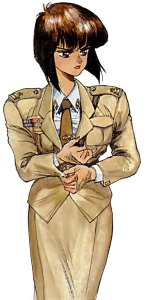
Surprisingly, Mamoru Oshii, director of the original anime, has stated he thinks casting Scarlett Johansson as Kusuanagi is perfect because “her physical form is an entirely assumed one. The name Motoko Kusanagi and her current body are not her original name and body, so there is no basis for saying that an Asian actor must portray her.”³ He’s right that the Major doesn’t appear to be a specific ethnicity in the anime. But the same is true of many anime characters. More damningly, in the manga Kusanagi is depicted with dark, typically Asian-looking hair and slanted eyes, as shown on the right. Oshii also states that GITS is set in future Hong Kong, which the LAV creators said they respected, and which is dead wrong. As the Wikipedia article states, the GITS franchise is “primarily set in the mid-twenty-first century in the fictional Japanese city of Niihama, Niihama Prefecture (新浜県新浜市 Niihama-ken Niihama-shi), otherwise known as New Port City (ニューポートシティ Nyū Pōto Shiti)”.†
Even in the anime, her eyes appear to be Asian, directly undercutting Oshii’s argument. It’s entirely reasonable to believe that Kusanagi’s cyborg body was designed to look Asian, especially once you take into account the ethnic homogeneity preferred by Asian cultures. And in the LAV (spoiler alert), she turns out to be Japanese after all!
The LAV also makes other odd choices. Though its setting is future Hong Kong, the background chatter is Japanese rather than Chinese or the mishmash of Chinese and Japanese spoken by Hong Kong natives. Adding to the confusion, the chief of Section 9, Daisuke Aramaki (荒巻 大輔), speaks Japanese throughout the LAV. (Very poorly enunciated and thus difficult to understand Japanese.) I’m usually all for subtitling rather than changing the language, but the language wasn’t appropriate for the setting (unless we’re to understand that Japan has taken over Hong Kong again, in which case, why not just set it in Japan? The canon is set in Japan anyway!), it was difficult to keep switching between Japanese and English comprehension, and the subtitles were inaccurate.
More mysteries are in the iconic scene where Kusanagi drops from the roof to crash the business meeting. First, the LAV takes two different scenes from the canon—the roof drop and the hacked geisha taking over the official’s cyber brain—and mashes them into one. Secondly, in the canon Kusanagi uses a bungee or rappel cord to anchor her descent. In the LAV she appears to free fall without any safety device. As she falls in the canon, her camouflage renders her invisible. In the LAV she remains visible until the film cuts to inside the teahouse.
This brings me to costuming and the presentation of Kusanagi’s body. The LAV made the odd choice to make the Major’s body armor nearly white (it’s charcoal in the canon). It also looks more like a leotard than functional armor. From what I saw (about half the film), Johansson doesn’t appear to wear either Kusanagi’s formal uniform (see above right for an example from the manga) or her default “corset and thong”‡ outfit (see above left for an example from the anime). The omission of Kusanagi’s sexy default outfit may be an attempt to downplay her sexuality. The decision to not make Johansson’s bust size match the character’s—there appears to be a three- to four-cup-size difference—likewise desexualized her. In the scene where Killian (remember her name was changed for the LAV) is being repaired after getting blown up, her bust appears almost flat. This scene is also interesting because the framing and the way in which Killian’s body is depicted fits neatly into feminist criticism of the way the media often slices women into sexualized parts.
Obviously there’s a lot to criticize in the LAV. I hope Netflix does a better job with the live action version of Death Note it’s announced, but have strong doubts. (By the way, “A Netflix Original Film” [emphasis mine]? I don’t think so!)
THE BOTTOM LINE: 
I give this film five steaming piles of poo. Even the computer graphics eye-candy cannot save this one. Fans should avoid and protest the whitewashing loudly.
¹ Japanese names are Anglicized (Given Name followed by Surname) to maintain consistency within this post.
² “Public Security Section 9.” Wikipedia. August 05, 2017. Accessed August 30, 2017. https://en.wikipedia.org/wiki/Public_Security_Section_9.
³ Rose, Steve. “Ghost in the Shell’s whitewashing: does Hollywood have an Asian problem?” The Guardian. March 31, 2017. Accessed August 29, 2017. https://www.theguardian.com/film/2017/mar/31/ghost-in-the-shells-whitewashing-does-hollywood-have-an-asian-problem.
† “Ghost in the Shell.” Wikipedia. August 28, 2017. Accessed August 30, 2017. https://en.wikipedia.org/wiki/Ghost_in_the_Shell#Setting.
‡ Shelton, William. “Doing Sexy Right: A Look at Ghost in the Shell’s Major Motoko Kusanagi.” Poor Mans Geek. September 27, 2015. Accessed August 29, 2017. https://poormansgeek.wordpress.com/2015/09/27/doing-sexy-right-a-look-at-ghost-in-the-shells-major-motoko-kusanagi/.

 Honeycomb's Hive