 Today my dog Panda Bear is twelve! She might not have made it, though. Yesterday my father left an open package of chocolate chip cookies on the floor by his recliner. Naturally, Panda got into them. Luckily, my mom came running when she heard the noise and stopped her.
If you have a dog in your life, you’re probably aware that chocolate is poisonous to dogs. You may not know (I didn’t) that the toxicity depends on the type of chocolate as well as the amount ingested. As far as we could tell, Panda had eaten a maximum of 1 oz, but what kind? We used PetMD’s Chocolate Toxicity Meter to determine the possible danger. 1 oz of milk chocolate would be subtoxic for her, while the same amount of baker’s chocolate would be deadly.
We examined the nutrition panel for clues. It was hard to read, especially in a panic. It was difficult to tell the difference between brackets and parentheses, and where they began and ended. Nor does the ingredients list simply state the type of chocolate. We had to figure it out from what was in the chips. Close inspection determined they were semisweet, cause for concern.
We called the Pet Poison Helpline (855-213-6680) (there is a fee for this service. We paid almost $60). They asked us her breed, weight, symptoms, and about any other health issues. They researched the cookies and determined she would probably be okay, though we should watch her.
Luckily, Panda Bear is fine and enjoying a very happy twelfth birthday. But this incident is just one example of a big problem with food labeling.
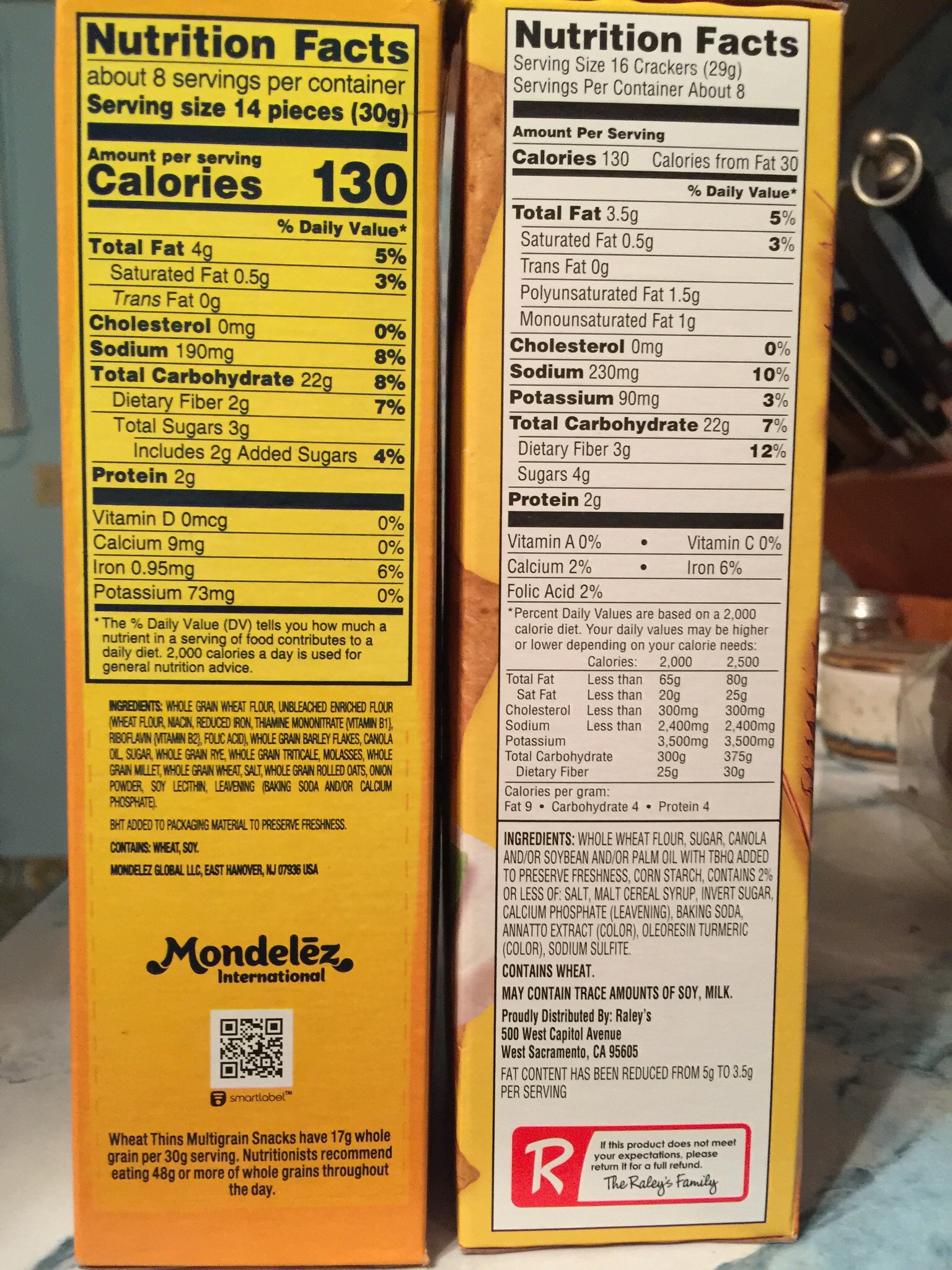
Take a look at the nutrition information on the two boxes to the right. Pay attention to the formatting and design rather than content. What do you notice?
The most important information, the ingredients, is the hardest to read! The ingredients list is typed in one of the smallest fonts on the package. It’s also in narrow ALL CAPS, making it more difficult to read than the even tinier QR label branding on the left-hand box.
Why is the ingredient list the most important information on the box? Many people have medical issues that are caused or exacerbated by certain ingredients. To use an extreme example, trace amounts can cause anaphylaxis, a life-threatening condition. Pets can also be at risk, as shown above. Knowing what’s in your food is thus much more immediately important than calorie counts or vitamin percentages.
Food companies have responded to the prevalence of food allergies by alerting consumers to the presence of a few commonly problematic ingredients. They call wheat, milk, soy, and nuts out separately in bold type. But this is not good enough. They use the same tiny ALL CAPS typeface as in the full ingredient list. Furthermore, there are many other foods that can cause medical emergencies. I used to get anaphylaxis if I ate or drank anything containing gums or resins commonly used as thickeners and preservatives.
When I saw an allergist earlier this Fall, he shared that another patient had anaphylaxis after eating a candy bar. The vital information was concealed underneath a fold in the wrapper, written in type so tiny he needed a magnifying glass to read it.
Ingredients need to be listed in large, clear type in an easily visible location on the package. Not in ALL CAPS. This information, or a QR code leading to it, needs to appear on individually wrapped items. Food purveyors must make it easy to find a complete and accurate ingredient list online. Currently many restaurants make it really hard to find their nutrition information and only include a list of common allergens, not a complete ingredient list. This is a dangerous and unacceptable practice which must change.
In addition, consumers need to be able to easily and quickly identify the date a recipe was last revised. This will alert consumers when they need to carefully review the ingredients again. This is important because when the recipe changes without notice, consumers are at higher risk of injury or death from new, unexpected ingredients.
 Honeycomb's Hive
Of all the places, I believe the answer to this comes from…a tube of aquarium test strips. The last one I bought had a peel-back label. The outside had instructions for using the strips; when you pulled it away from the tube by one corner, the label opened like a book cover. Effectively, the label was three times the size of one that didn’t open. There was room for instructions printed at a reasonable size, and a chart to compare the results to. Imagine how much room there would be on a label like the ones on those boxes.
LikeLiked by 1 person
Great idea, Maia! I also think larger packages, like cracker or cereal boxes, could easily be redesigned to give more room to important information and less to trumpeting their own product.
LikeLike
Nutrition info on the back, ads on the side would make the most sense, it seems to me. You don’t see the back on the shelf anyway. Hey, then they could spare a line or two for diabetics, too; I have to literally stand there doing math every time I consider a new product.
The example I most often use: Pick up the regular-size single-serve bag of Peanut M&Ms. How long will it take you to determine that a person with a peanut allergy shouldn’t eat them? About half a second, considering “peanut” is in the name (as well as in the ingredients, and in the allergy warning)?
Here’s the nutrition label:
http://www.myfitnesspal.com/food/calories/m-ms-peanut-m-ms-1-74-oz-bag-316197461
How much of that bag is a serving for a diabetic person? How long would it take you to determine that? Can you without being taught how? (The answer is half the bag, by the way.)
LikeLiked by 1 person
I agree and that’s a great example. I wouldn’t have a clue how much a diabetic should eat. I imagine it also varies with your insulin level? Considering how widespread an issue diabetes is, this info should definitely be included!
LikeLike
All it would take was one line listing the servings per package based on carbs. There are a lot of variables, some personal (my glucose will spike hard if I drink even an proper serving of fruit juice, but I can eat fruit safely), but the base info is that 15 to 20 grams of carbs is a serving. Armed with that, you math it up.
I don’t see food at all in the same way any more. Early on after my diagnosis, I picked up a can of non-diet soda out of curiosity (I’ve never liked it; it’s too sweet for my taste), then put it down and said bad words. I could have that soda, or I could have a pork chop, a small dinner roll with butter, a big salad with dressing, a piece of fruit, and a granola bar (my dinner that night). Same carbs.
LikeLiked by 1 person
Woah! No wonder drinking soda can be a huge factor in weight loss/gain! Like most folks, I’ve been trained to think of calories as the most important number, but it sounds like carbs could be even more important for everyone, not just diabetics. When it would take so little to make good food choices easier, it’s infuriating it’s not done. I see a letter to the FDA in my future.
LikeLike
Carbs make a massive difference in weight loss. Starting on Metformin (an oral diabetes med) made a huge difference for me, but so did changing how I ate. As you can tell from that meal, I was (and am) a long way from starving myself, and I lost 30 pounds the first three months; it absolutely just fell off.
LikeLiked by 1 person
Amazing! Great work, Maia! I’ve been struggling with my own weight. I’ve switched to eating mostly homemade soup, which helped. The biggest factor for me seems to be exercise, though. I’m limited by chronic pain and illness, which is extremely frustrating. But when I can get a move on it makes a big difference. One reason I play Pokémon Go is that it helps motivate me to walk.
LikeLike
I’m horrible about exercise; I don’t enjoy it at all. Alec’s already started dragging me out the door in the evening for a walk again, but it’s definitely not full-on exercise walking. I have chronic bursitis in one knee, and it’s really easy to throw it out with any kind of unnatural stride. But regular walking actually helps with it, so that’s another reason to get out there.
I think what helped me most with the carb-based approach is that most diets tell you what you can and can’t eat, and variety is a really big thing for me. I get bored with the same foods very easily, and goodbye diet. This way, I can eat pretty much whatever I want; the key is how much of it. As I said, a few things I do avoid because they really do a number on me, but a lot of the things I thought I’d miss, I don’t even bother with any more. It’s weird how many things I used to love and can no longer eat because they taste sickeningly sweet to me now. I wonder how in the world I ever choked the stuff down to start with. 🙂
LikeLiked by 1 person
Exercise helps with my pain, too. I have CRPS from burns. It’s counter-intuitive when you hurt, isn’t it? My dog Panda is a great PT coach. 🙂
My downfall with carbs is my love of bread. 🙂 It is amazing how much of our dietary likes and dislikes are determined by habit. I had a similar experience a couple weeks ago. I had a craving for yogurt-covered raisins, which I loved as a child. I bought a small bag, but as soon as I ate 2, I was done. So sweet! LOL!
BTW, I’m enjoying this conversation! 😀
LikeLike
Me, too. 🙂
I was surprised to find how bad my eating habits were. I’d wager my diet was better than 75% of Americans even before I was diagnosed. My father had a triple bypass after congestive heart failure several years earlier, so I’d cut a lot of saturated fat and nearly all added salt out of my diet when I spent a year cooking for him and trying to teach him the new habits. One huge problem came from somewhere I’d never have guessed.
I have a circadian rhythm disorder that throws my body clock off the norm by about 6 hours, so I fell into the habit of not having an evening meal. Which might have been okay, but I’d end up garbage-gutting at 2 am instead. The first thing the doctor pointed out was that in my case, the whole “Don’t eat after 8 pm” thing was complete bull for me, because 8 pm is my early afternoon. It’s like telling someone who sleeps normally not to eat after 2 pm. So I have breakfast at noon, lunch around 5 or 6 pm, and supper around 10 to 11 pm. Since I married a much more normal sleeper, that means in practical terms I eat lunch for breakfast, supper for lunch, and breakfast for supper. *laugh*
My other problem was that in trying to do good, I was actually trying to kill myself. 😀 Feeling the urge for candy? Okay — skip all the stuff with the saturated fat and cholesterol and even salt. Sour gummy worms (my candy weakness above all others) don’t have any of that junk. Of course not. Pure sugar doesn’t. Uh…oops.
LikeLiked by 1 person