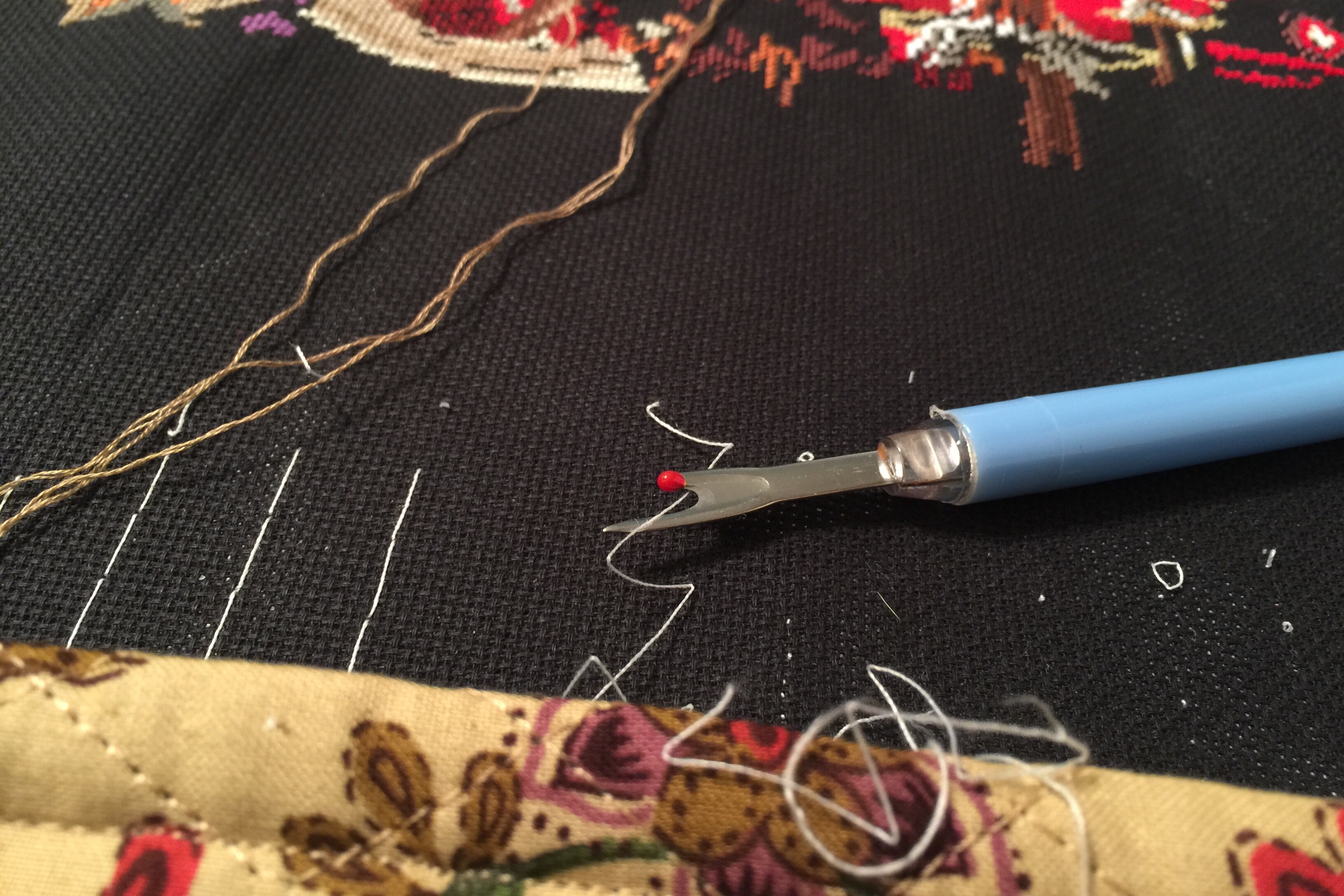
When I embarked on my current counted cross stitch project, I decided to try out a tip. I used white thread to stitch a 10 x 10 grid on my aida cloth. This reference did make it much easier and faster to stitch as it reduced the need to carefully count. I could determine the location of any stitch primarily spatially and never had to count higher than five to find my place.
But once I’d completed the top of the piece, I decided to test the tipster’s assertion that the grid stitches would be easy to remove. Turns out it’s a very finicky process. I wound up accidentally cutting a couple of cross stitches and having to leave some grid thread pieces where they were inconspicuous so I didn’t cut more of my project. I removed the grid threads from the rest of my fabric and don’t think I’ll use this method again.
My troubles with gridding my cross stitch project made me think about my struggles with outlining. I’m what’s often referred to as a “pantser” because I write by the seat of my pants instead of relying on an outline. I usually have a general idea of where I’m headed and even have some detailed scenes I know I want to get to along the way, like taking a road trip and penciling in a few must-see destinations and an end point, but leaving the rest up to serendipity. I’m one of those authors to whom her characters are very real, separate beings who tell me their story. My job is to listen and record, sometimes running along after shouting, “Wait! I can hardly keep up!”
Writing with an outline feels very restrictive to me, rather like rally driving. When I was required to turn in outlines for school papers, I almost always wrote the paper first and then the outline. My sophomore year of high school I finally figured out a nonfiction outlining style that worked for me. Using 3″ x 5″ cards I wrote down the points I wanted to make and supporting information. Then I sat down and rearranged the cards until I had a stack that led me almost from sentence to sentence. But I’ve only done this for thesis-length research papers. And for fiction, it feels too regimented and constricting.
I’ve heard a lot of great things about different styles of outlining, like the grid or post-it notes, and I keep trying because it seems like such a good idea. I have yet to find my match, though.
How do you feel about outlining first? What works best for you? I’d love to hear about it in the comments.
 Honeycomb's Hive
I know this is an old post, but I enjoy seeing and reading other people’s in-progress experience and advice on whichever same cross stitch project I’m working on. Thanks for yours on Scarlet Wizard!
With regards to your experience with removing guide-lines, I had exactly the same problem (and with the same colour!) when It came time to remove the lines from my Fall Fairy project – the threads that had been stitched through were SO hard to remove, I think I pulled some of them out with pliers in the end!
You can actually get proper thread for doing guide-lines, in red – but it is horribly expensive, so I found a reasonable alternative in ‘silver sulky’ thread from Gutermann. It’s like thin plastic metallic ribbon and comes in a lot of different colours. You can use thin coloured fishing line too, I think, but I preferred to use the Sulky because it’s flat and won’t ‘fill’ the holes in the fabric and make it harder to get the floss through – with some of the stitches in this one being (urgh!) three-strand full crosses, I thought that might be a big advantage. I think it’s totally worth it, the guide-lines are so useful and have saved me a lot of mistakes and counting errors!
LikeLiked by 1 person
Sorry we are so late to seeing this comment and thank you so much for the tip on guideline threads! Next time we try that technique we will give the Gutermann a try. Did you finish Scarlet Wizard? How’d yours turn out?
LikeLike