Blog News

Hello, dear readers! Thank you for the warm welcome to the blogosphere!💖 I appreciate every like, comment, and follow I’ve received. I hope I always have the same giddy response to each interaction and that you continue to enjoy my posts. I’ve been intimidated by the current requirement for writers to have a “social media presence”, but y’all have made it a lot less scary. It feels doable and fun now! Blogging has also helped me develop a habit of writing something every day.

I do have to make some small changes to my blogging schedule. I’ve realized I don’t have enough energy to blog and work on my novel in the same day. So I’ve decided I’ll post on Monday, Wednesday, and Friday and devote the other days to novel writing.

I also want to devote more time to studying Japanese.🇯🇵 I want to increase my mastery of reading and writing in particular. So I’ll also post on Lang-8.com once a week and copy it here. If you also speak Japanese, please join me on Lang-8! I’m Rosemerry Song (ロズメール サング) there, too. Please be patient with my mistakes. 😊

(NB: As of this writing, there’s a freeze on new sign-ups to Lang-8 while they promote their new mobile app, HiNative. So if you’re already on Lang-8, I’ll see you there! If not, I hope to see you after the freeze is lifted.)

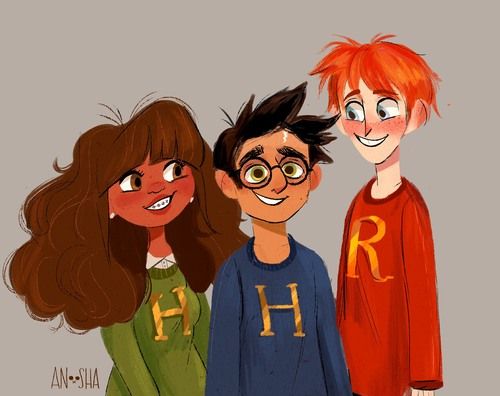
Fan art illustration of Hermione, Harry, and Ron from the Harry Potter series by Anoosha Syed.

Dear J. K. Rowling: I’m Confused

I was surprised when I came across this article on the BBC News website: “Backlash over illustrator’s black Hermione fan art”. And then I was confused.

Fan art illustration of Hermione, Harry, and Ron from the Harry Potter series by Anoosha Syed.

Anoosha Syed’s black Hermione is super cute! But, alas, confusing.

First, I’d like to say that writing a diverse cast of characters with regard to ethnicity, sexuality, gender identity, and so on without making it the focus or raison d’être is one of my goals. I’ve run into some problems because I’m untangling racism I didn’t realize I’d imbibed growing up and because it can be difficult to write the other, let’s be real. I’ve had to realize that you can’t please everybody and I just have to do my best to navigate these issues.

Now, Anoosha Syed argues that J. K. Rowling never states what race Hermione Granger is in the books. The closest she comes is one line in The Prisoner of Azkaban in which her skin is described as brown. So it’s not surprising that readers of all ethnicities would assume that she was their ethnicity. When done consciously, this process is called disidentification. When unconsciously, it’s called ethnocentrism. Syed further argues that Rowling selected a black woman, Noma Dumezweni, to play Hermione in the stage version. The author also retweeted her fan art, giving it the seal of approval.

Rowling’s actions are legitimately confusing for fans. She also selected Emma Watson, a white girl, to star in the film versions. Much was made of Rowling’s power to ensure accuracy in the films. And yet I’ve always been bothered by many inaccuracies that weren’t demanded by changing the medium. For example, in the books all of the Dursleys are clearly described multiple times as blond. Yet in the films they are brunettes. If the actors playing the Dursleys were the best available for the parts, hair dye or wigs could have easily fixed this problem.

So does Rowling herself not have a clear vision of what her characters look like? Does she just not care? Is she content to have multiple versions of her characters?

In a June 5, 2016 interview with The Guardian she says, “It was 17 years and just because I’ve stopped on the page doesn’t mean my imagination stopped.” So if the world of Harry Potter is still vivid in her mind, which casting choice better reflects her imagination?

In the same interview, Rowling addressed the controversy directly. “I decided not to get too agitated about it and simply state quite firmly that Hermione can be a black woman with my absolute blessing and enthusiasm,” she said.

“Can be a black woman.” (Emphasis mine.)

This wording suggests that Hermione was not originally a black woman in Rowling’s imagination, just that she’s okay with her character being portrayed as multiple races. She does not definitively state what ethnicity she had in mind when she wrote the Harry Potter series. So with the evidence at hand, I must conclude that Emma Watson best reflects Rowling’s vision. Watson was cast first and Rowling insisted the film accurately portrayed the books.

I understand Rowling’s impulse to embrace a more multicultural version of her characters. In essence, she is rewriting the Harry Potter series with her choices. And perhaps she didn’t have as much control over the films and play as purported. We’ll never really know. But I think a better and less confusing choice would have been acknowledging a black Hermione is a brilliant idea she wished she’d thought of, and then working to write with a wider color palette.

Link

Groove with Rosemerry!

Apple Music now allows you to see what friends are listening to and listen to their playlists a la Spotify. Check out my “Writer’s Candy” playlist, chock full of songs that inspire my writing. And please share your own favorite writing jams!

Free Speech, Flags, and Toilet Paper

This weekend the National Football League finally joined Colin Kapernick in protest. I’m sad that it took them so long, but am glad they’re finally doing it. This story has prompted a lot of thinking.

Back before 2009, when it became de rigueur for players to stand for the pledge of allegiance, I remember my hometown football team usually knelt for the pledge. Kneeling was considered a sign of profound respect. It’s fascinating that now President Trump and the alt-right argue it’s disrespectful. As one viewer tweeted to The Young Turks, if it’s disrespectful to kneel, why is it traditional to kneel when praying? According to Trumpian logic, wouldn’t that be saying “F you!” to God?

On the free speech angle, I was prompted to think about a photo I’d taken on my iPhone using a special camera app. Now I’ll be honest, sometimes when I glance in the toilet before flushing, I notice that the TP has formed a recognizable shape. This random origami, if you will, fascinates me. So sometimes I’ll take a picture of an especially good one.

A week or so before the 2016 election, I noticed the TP had made a beautifully expressive checkmark, as if the toilet bowl was a checkbox. This perfectly expressed my feelings about an election in which the leading choices were both pretty crappy and it was hard to feel like my vote mattered. I might as well flush my vote down the toilet. So I took a photo, though I wound up never posting it anywhere. Then a couple of months ago I opened the app only to discover that all of my photos had disappeared without warning! I don’t know this for certain, but it appears that the app may have deleted my content, even though I had kept it private, because they deemed my TP photos obscene and thus in violation of their TOS.

Now, as a private company the app had the right to do that, as much as I didn’t like it. But this brings up several questions. What is obscene? I could argue that a great deal of constitutionally protected speech is obscene. Does that mean that it should, therefore, not be heard? Where should we draw the line? I don’t think that the Nazi crowds in Charlottesville’s speech should be protected. I think it’s obscene, obvious hate speech, and incitement to violence. Yet some think that Colin Kapernick kneeling during the pledge of allegiance is obscene and hateful speech.

I’m not going to answer these questions here. But if I were in charge I would make changes to the pledge of allegiance. Doing so won’t solve any free speech issues, but it would remove some of the major objections to reciting it based on the wording.

I pledge allegiance to the United States of America. Many peoples creating one nation with freedom and justice for all.

This wording pledges allegiance directly to the nation, not to its flag. It also removes mention of God (I’d also remove “In God we trust” from US currency). Whatever one’s religious beliefs, church and state are supposed to be separate in the United States, so it’s inappropriate for God to be in our national pledge (or on our currency). Finally, this wording focuses on our history of melding immigrants from around the globe into one nation founded on constitutional principles.

This post has followed my thought association. So to thank those who’ve read this far and to return to TP origami, here’s an excerpt from a story in progress tentatively titled “Cordelia and the Shit Demon” that was inspired by this manifestation of serendipity. Enjoy:

            “Cordelia, why are you setting up the high-speed over the toilet?”

The small, mousy witch so addressed blushed and continued to adjust the video camera’s controls for a moment before replying. “You know I’m good at reading the tea leaves. Well, it turns out you can get a lot more interesting and accurate information reading toilet paper because of the – ahem – biological materials involved. Is something wrong?” She fiddled with the lapel of her robe, which was fraying from this nervous tic, and looked up at Pansy with concerned doe-like eyes. Rumor had it that Cordelia’s glasses were made with two magnifying glasses, a touch of magic, and a bit of wire. They certainly did enlarge her eyes in a way Pansy found both absurd and irresistible. She couldn’t scoff at the silly project with those brown orbs turned on her.

Giving in, Pansy crossed her arms and leaned against the doorjamb. “So why the high-speed? You never needed it for tea.”

Cordelia smacked her fist into her palm. “Oh, right! I didn’t say, did I? This camera,” she gestured like a model displaying a product, “will capture the flush cycle, in case it goes by too fast or there are nuances my eye alone can’t see. The tripod is set up to breakdown quickly so my scrying will occupy the bathroom for the least time possible.” The little witch beamed.
Vincente for Presidente and the US Electoral System

If you haven’t already seen former Mexican President Vincente Fox’s YouTube videos addressing US President Donald Trump, you should. They’re hilarious. Here’s one of my favorites:

https://www.youtube.com/watch?v=-ukv9v7IGZw

Vincente Fox’s humor makes me think he’d make a wonderful US presidential candidate, though I know nothing of his policies. This also made me reflect on a high school friend who wanted to be POTUS, but couldn’t because he was born in China prior to his parents’ immigration. While I understand the reasons for not allowing people like my friend to run for president, it saddens me that we lose out on some folks who would make fantastic elected officials.

I often think about what I would do if I was in charge. This helps me both think through the issues and build story worlds in which I can experiment with those policies and their opposites. Donald Trump’s election helped bring debate over the electoral college to the forefront. Before Trump was elected, many of my friends and I were for abolishing the electoral college. But once Trump’s election was on the horizon, I changed my mind.

The founders wrote the electoral college into the constitution as a fail-safe measure. They envisioned the electors’ job as preventing demagogues and unqualified or incompetent candidates from rising to power. Yet in the 2016 presidential election, they arguably failed to do so.

I believe this failure is the result of the way the electors’ job description is written. Electors are told they are “faithless” if they do not vote for the candidate who wins the majority of votes in their state. Many states fine faithless electors. With this state of affairs, we might as well eliminate the electoral college and implement true direct democracy. But we need electors to be the nation’s failsafe. So I’d rewrite their job description to be explicit about their mandate to prevent demagogues from achieving office. A faithless elector would be one who failed to prevent another Trump from becoming POTUS. How the nation would determine the president-elect is unacceptable would need to be spelled out. When there is not an untenable candidate in the race, electors would simply be required to certify the accuracy and legitimacy of their state’s vote tallies (so rather than voting for a candidate as in the current winner-take-all system, the certified state vote tallies would be added to those of all other states, creating a nationwide popular vote). This would mean acting to eliminate voter suppression, ensuring security, and eliminating fraud.

I would also make nationwide changes to the voting process. Election Day would be moved to Monday and declared a federal holiday. I would follow Australia’s example and pass a law requiring all eligible US citizens to vote. To make that easier, I would create an electronic, online voting system that would allow people to vote from the convenience of the nearest online device. I’d supplement this system with vote by mail and polling stations at every library and school computer center to ensure access. Naturally, this would require strong security protocols, but I’m convinced it can be done.

If you were in charge, how would you change the United States’ voting system?

To Grid or Not to Grid

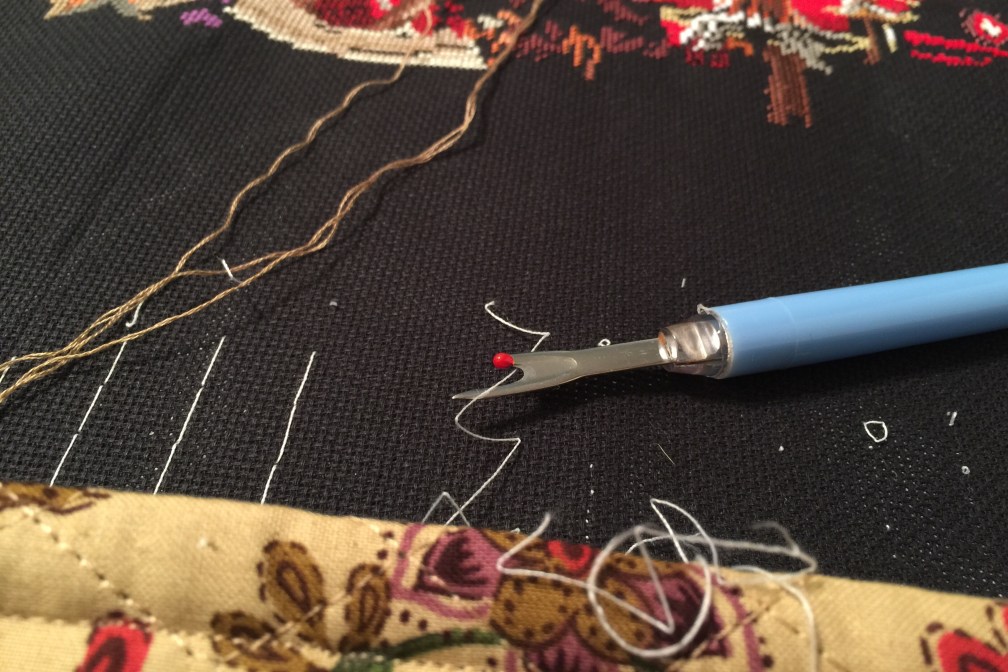
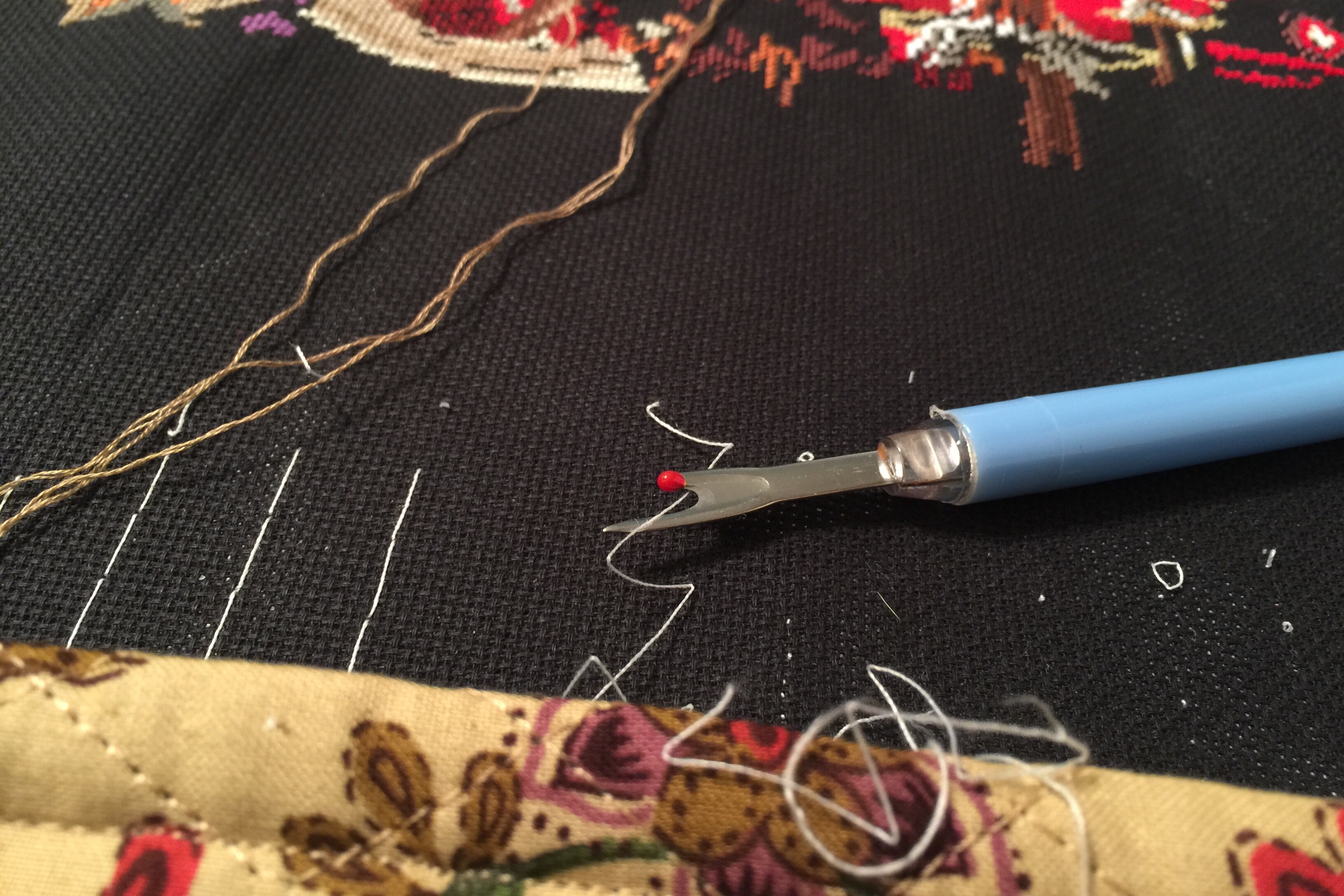
When I embarked on my current counted cross stitch project, I decided to try out a tip. I used white thread to stitch a 10 x 10 grid on my aida cloth. This reference did make it much easier and faster to stitch as it reduced the need to carefully count. I could determine the location of any stitch primarily spatially and never had to count higher than five to find my place.

But once I’d completed the top of the piece, I decided to test the tipster’s assertion that the grid stitches would be easy to remove. Turns out it’s a very finicky process. I wound up accidentally cutting a couple of cross stitches and having to leave some grid thread pieces where they were inconspicuous so I didn’t cut more of my project. I removed the grid threads from the rest of my fabric and don’t think I’ll use this method again.

My troubles with gridding my cross stitch project made me think about my struggles with outlining. I’m what’s often referred to as a “pantser” because I write by the seat of my pants instead of relying on an outline. I usually have a general idea of where I’m headed and even have some detailed scenes I know I want to get to along the way, like taking a road trip and penciling in a few must-see destinations and an end point, but leaving the rest up to serendipity. I’m one of those authors to whom her characters are very real, separate beings who tell me their story. My job is to listen and record, sometimes running along after shouting, “Wait! I can hardly keep up!”

Writing with an outline feels very restrictive to me, rather like rally driving. When I was required to turn in outlines for school papers, I almost always wrote the paper first and then the outline. My sophomore year of high school I finally figured out a nonfiction outlining style that worked for me. Using 3″ x 5″ cards I wrote down the points I wanted to make and supporting information. Then I sat down and rearranged the cards until I had a stack that led me almost from sentence to sentence. But I’ve only done this for thesis-length research papers. And for fiction, it feels too regimented and constricting.

I’ve heard a lot of great things about different styles of outlining, like the grid or post-it notes, and I keep trying because it seems like such a good idea. I have yet to find my match, though.

How do you feel about outlining first? What works best for you? I’d love to hear about it in the comments.