Food Labels are Crackers

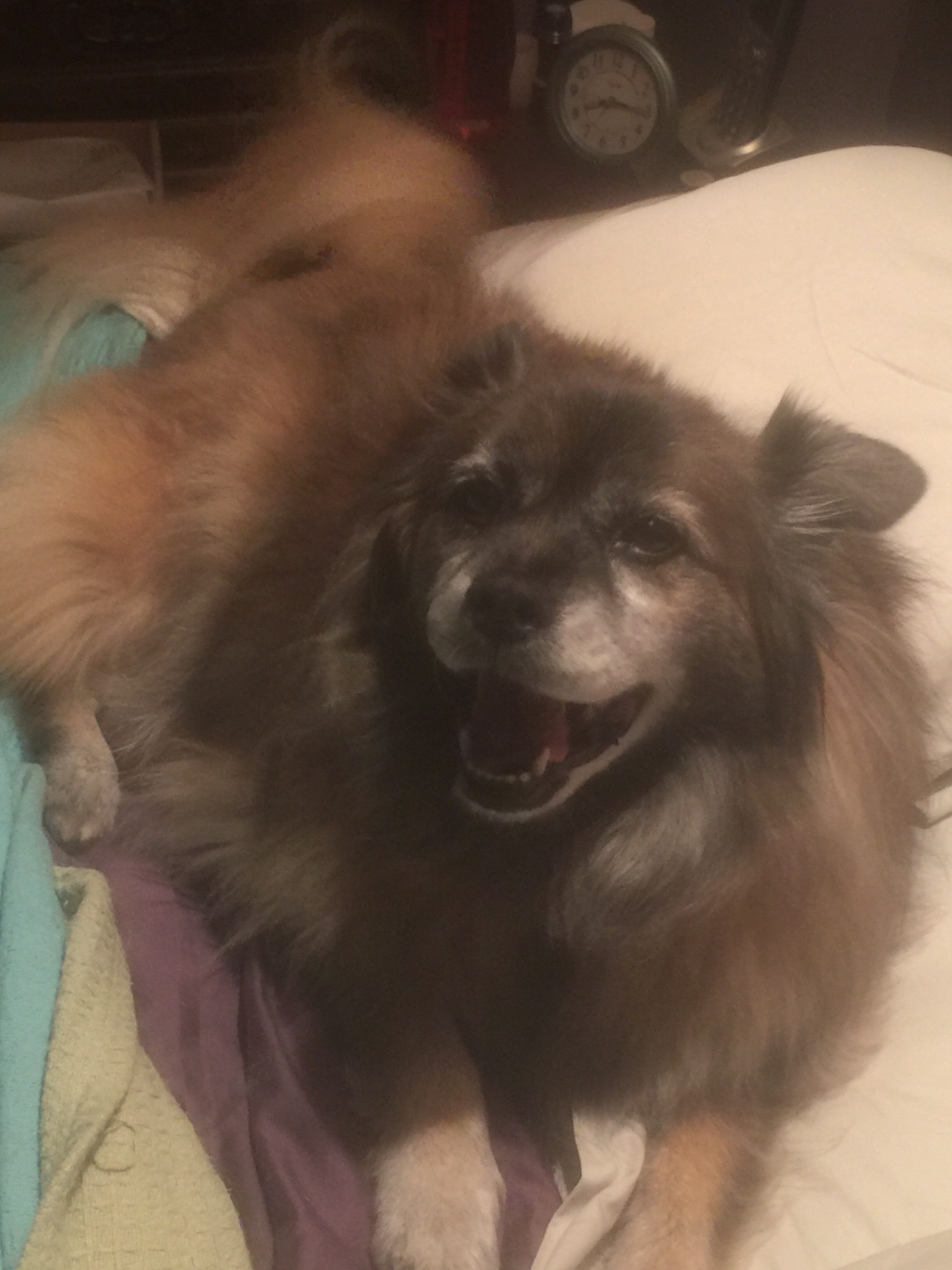
Today my dog Panda Bear is twelve! She might not have made it, though. Yesterday my father left an open package of chocolate chip cookies on the floor by his recliner. Naturally, Panda got into them. Luckily, my mom came running when she heard the noise and stopped her.

If you have a dog in your life, you’re probably aware that chocolate is poisonous to dogs. You may not know (I didn’t) that the toxicity depends on the type of chocolate as well as the amount ingested. As far as we could tell, Panda had eaten a maximum of 1 oz, but what kind? We used PetMD’s Chocolate Toxicity Meter to determine the possible danger. 1 oz of milk chocolate would be subtoxic for her, while the same amount of baker’s chocolate would be deadly.

We examined the nutrition panel for clues. It was hard to read, especially in a panic. It was difficult to tell the difference between brackets and parentheses, and where they began and ended. Nor does the ingredients list simply state the type of chocolate. We had to figure it out from what was in the chips. Close inspection determined they were semisweet, cause for concern.

We called the Pet Poison Helpline (855-213-6680) (there is a fee for this service. We paid almost $60). They asked us her breed, weight, symptoms, and about any other health issues. They researched the cookies and determined she would probably be okay, though we should watch her.

Luckily, Panda Bear is fine and enjoying a very happy twelfth birthday. But this incident is just one example of a big problem with food labeling.
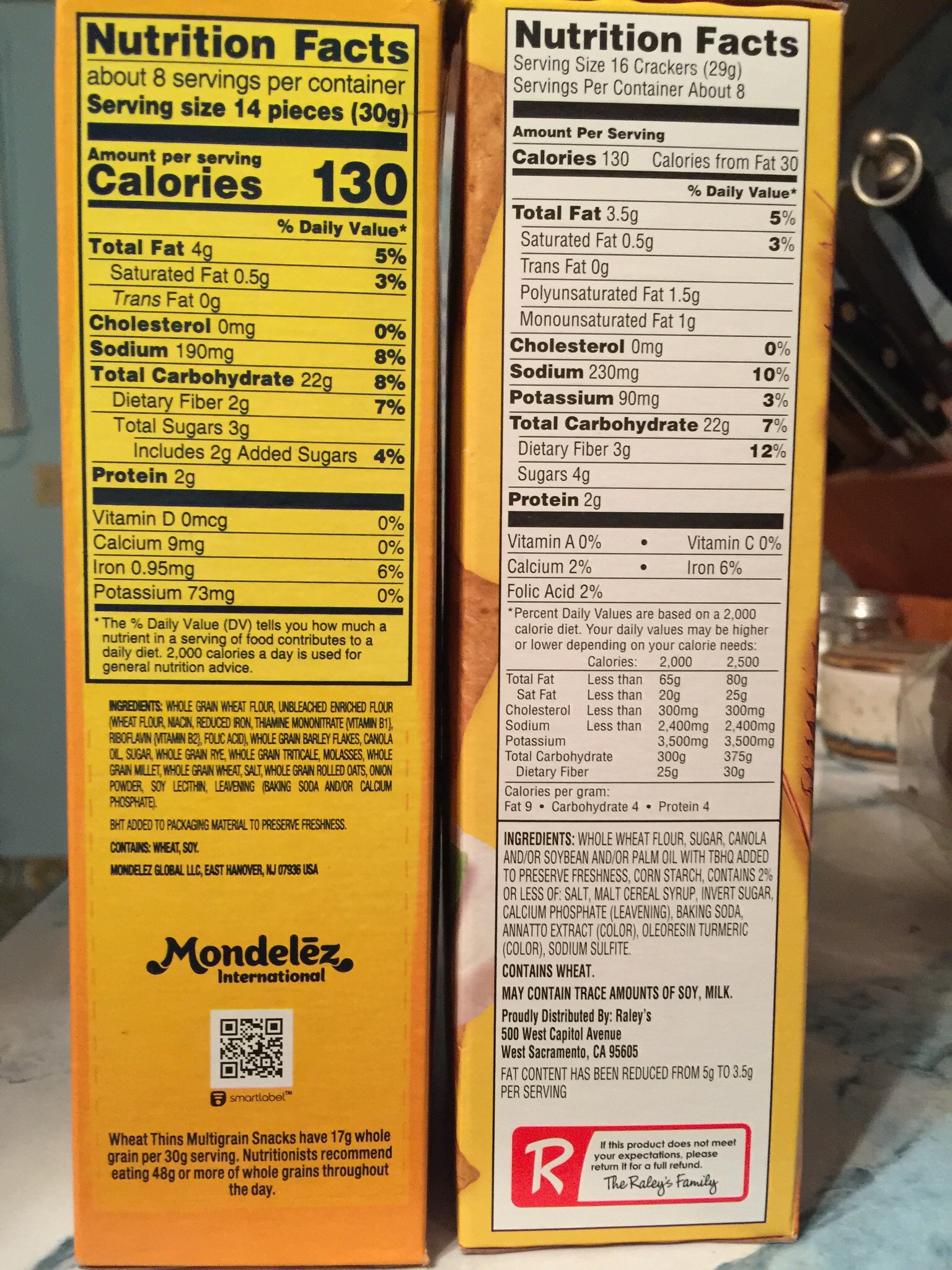
Take a look at the nutrition information on the two boxes to the right. Pay attention to the formatting and design rather than content. What do you notice?

The most important information, the ingredients, is the hardest to read! The ingredients list is typed in one of the smallest fonts on the package. It’s also in narrow ALL CAPS, making it more difficult to read than the even tinier QR label branding on the left-hand box.

Why is the ingredient list the most important information on the box? Many people have medical issues that are caused or exacerbated by certain ingredients. To use an extreme example, trace amounts can cause anaphylaxis, a life-threatening condition. Pets can also be at risk, as shown above. Knowing what’s in your food is thus much more immediately important than calorie counts or vitamin percentages.

Food companies have responded to the prevalence of food allergies by alerting consumers to the presence of a few commonly problematic ingredients. They call wheat, milk, soy, and nuts out separately in bold type. But this is not good enough. They use the same tiny ALL CAPS typeface as in the full ingredient list. Furthermore, there are many other foods that can cause medical emergencies. I used to get anaphylaxis if I ate or drank anything containing gums or resins commonly used as thickeners and preservatives.

When I saw an allergist earlier this Fall, he shared that another patient had anaphylaxis after eating a candy bar. The vital information was concealed underneath a fold in the wrapper, written in type so tiny he needed a magnifying glass to read it.

Ingredients need to be listed in large, clear type in an easily visible location on the package. Not in ALL CAPS. This information, or a QR code leading to it, needs to appear on individually wrapped items. Food purveyors must make it easy to find a complete and accurate ingredient list online. Currently many restaurants make it really hard to find their nutrition information and only include a list of common allergens, not a complete ingredient list. This is a dangerous and unacceptable practice which must change.

In addition, consumers need to be able to easily and quickly identify the date a recipe was last revised. This will alert consumers when they need to carefully review the ingredients again. This is important because when the recipe changes without notice, consumers are at higher risk of injury or death from new, unexpected ingredients.
Please Spare the Air

Did you know that air pollution causes 1 in 6 deaths worldwide?

I don’t know what the study authors considered pollution, but it’s made up of more than car exhaust and aerosols. One reason I love this great PSA by Spare the Air is that it brings to mind two other major air pollutants:

Yes, wood smoke can be as harmful to your health as secondhand smoke! And many folks don’t just burn well-seasoned wood. Duraflame is a popular firewood brand that contains chemicals to help it start easier. A lot of folks use charcoal briquettes to start fires, which were originally a byproduct of making car tires. I had a babysitter who burned all her trash, including milk jugs. So it’s important to raise awareness about the health effects of fires at home.

When I say, “spare the air,” I think about two other big sources: scents and non-tobacco-smokables.

While here in California we’ve succeeded in making smoking tobacco less cool and keeping most indoor spaces tobacco-free, the same laws do not apply to non-tobacco products such as electric cigarettes and marijuana. As vaping has grown in popularity and weed has become legal, I’ve seen proponents using these products in non-smoking areas. There’s a large camp of vapers and marijuana smokers that contend these products are not harmful. But vaping has a litany of health risks for both vapers and bystanders, including “popcorn lung” and nanoparticles of metal. This article lists just 10 of the dangers. After researching the matter, the University of California banned e-cigarettes and vaping, citing health risks. As far as smoking marijuana goes, I am well aware of the health benefits and use the plant in edible and tincture form myself. I shouldn’t have to worry about secondhand marijuana smoke from my neighbor making me high and compromising my safety, though.

Exposure to scents is a huge, under-recognized problem. A recent study found that

fragrance sensitivity is not only a common issue, but can be quite severe. One-third of the study participants reported experiencing one or more health issues from scented products (whether they used the items themselves, or were exposed to them in public places).

I can testify to this myself, as other people’s fragrances have sent me to the emergency room multiple times. When I’m at my most sensitive, I’m confined in my home. Yet even becoming a hermit does not save me from scents’ pervasiveness. My neighbor uses scented laundry products, so every time they do the laundry I have to rush inside and batten down the windows. A simple trip to the drug store is a major challenge as it’s filled with fragrances from all the products they carry.

Even if you are not sensitive to scents or chemicals, you should be concerned about their inescapability. In 2011,

A survey of selected scented consumer goods showed the products emitted more than 100 volatile organic compounds (VOCs), including some that are classified as toxic or hazardous by federal laws.1 Even products advertised as “green,” “natural,” or “organic” emitted as many hazardous chemicals as standard ones.

The University of Washington, Seattle tested 25 different products, many of them leaders in their category.

A single fragrance in a product can contain a mixture of hundreds of chemicals, some of which (e.g., limonene, a citrus scent) react with ozone in ambient air to form dangerous secondary pollutants, including formaldehyde.2 The researchers detected 133 different VOCs. Most commonly detected were limonene, α- and β-pinene (pine scents), and ethanol and acetone (often used as carriers for fragrance chemicals).1

Who wants to breathe formaldehyde? Who wants their children and pets breathing in acetone? Strange, I don’t see any raised hands…

We as a society need to raise awareness about these health risks and take action to mitigate them. Yes, that would likely mean eliminating fragrances in millions of products and perhaps the end of the perfume industry. It would mean eliminating vaping and smoking of all kinds. It would mean converting homes which wish to have hearth fires from wood to natural gas, and perhaps also adding filters to chimneys.

Most of all, it requires thinking about consent. Air is a shared resource. I do not consent to breathe the scent, marijuana, wood smoke, or e-cigarette vapor others spread via the air. Yet I do not have a choice. No one should be forced to breathe harmful substances. So let’s spare the air, and each other.

Trump, King of Dulness

I’ve been listening to Alexander Pope’s collected poems. I was first inspired to do so by Anne McCaffery, whose characters often reference the poet. I was particularly struck by “The Dunciad”, a poem about crowning the King of Dulness (sic) and expanding Dulness’ empire. Pope is at his best when his tongue is sharpest, and “The Dunciad” could read as a screed against Trumpism and the creep of anti-intellectualism. Great literature remains relevant, but in light of today’s news about Roy Moore, Pope seems prescient:

All as a partridge plump, full fed and fair,

She form’d this image of well-bodied air;

With pert flat eyes she window’d well its head,

A brain of Feathers, and a heart of Lead;

And empty words she gave, and sounding strain,

But senseless, lifeless! idol void and vain!

Never was dash’d out, at one lucky hit,

A Fool so just a copy of a Wit;

So like, that Critics said, and Courtiers swore,

A Wit it was, and call’d the phantom Moore.

Pope, Alexander. “The Dunciad”, Book II, 41-50. In The complete poetical works of Alexander Pope. Boston: Houghton, Mifflin, 1903. Accessed September 26, 2017. http://www.bartleby.com/203/164.html.

Free Speech, Flags, and Toilet Paper

This weekend the National Football League finally joined Colin Kapernick in protest. I’m sad that it took them so long, but am glad they’re finally doing it. This story has prompted a lot of thinking.

Back before 2009, when it became de rigueur for players to stand for the pledge of allegiance, I remember my hometown football team usually knelt for the pledge. Kneeling was considered a sign of profound respect. It’s fascinating that now President Trump and the alt-right argue it’s disrespectful. As one viewer tweeted to The Young Turks, if it’s disrespectful to kneel, why is it traditional to kneel when praying? According to Trumpian logic, wouldn’t that be saying “F you!” to God?

On the free speech angle, I was prompted to think about a photo I’d taken on my iPhone using a special camera app. Now I’ll be honest, sometimes when I glance in the toilet before flushing, I notice that the TP has formed a recognizable shape. This random origami, if you will, fascinates me. So sometimes I’ll take a picture of an especially good one.

A week or so before the 2016 election, I noticed the TP had made a beautifully expressive checkmark, as if the toilet bowl was a checkbox. This perfectly expressed my feelings about an election in which the leading choices were both pretty crappy and it was hard to feel like my vote mattered. I might as well flush my vote down the toilet. So I took a photo, though I wound up never posting it anywhere. Then a couple of months ago I opened the app only to discover that all of my photos had disappeared without warning! I don’t know this for certain, but it appears that the app may have deleted my content, even though I had kept it private, because they deemed my TP photos obscene and thus in violation of their TOS.

Now, as a private company the app had the right to do that, as much as I didn’t like it. But this brings up several questions. What is obscene? I could argue that a great deal of constitutionally protected speech is obscene. Does that mean that it should, therefore, not be heard? Where should we draw the line? I don’t think that the Nazi crowds in Charlottesville’s speech should be protected. I think it’s obscene, obvious hate speech, and incitement to violence. Yet some think that Colin Kapernick kneeling during the pledge of allegiance is obscene and hateful speech.

I’m not going to answer these questions here. But if I were in charge I would make changes to the pledge of allegiance. Doing so won’t solve any free speech issues, but it would remove some of the major objections to reciting it based on the wording.

I pledge allegiance to the United States of America. Many peoples creating one nation with freedom and justice for all.

This wording pledges allegiance directly to the nation, not to its flag. It also removes mention of God (I’d also remove “In God we trust” from US currency). Whatever one’s religious beliefs, church and state are supposed to be separate in the United States, so it’s inappropriate for God to be in our national pledge (or on our currency). Finally, this wording focuses on our history of melding immigrants from around the globe into one nation founded on constitutional principles.

This post has followed my thought association. So to thank those who’ve read this far and to return to TP origami, here’s an excerpt from a story in progress tentatively titled “Cordelia and the Shit Demon” that was inspired by this manifestation of serendipity. Enjoy:

            “Cordelia, why are you setting up the high-speed over the toilet?”

The small, mousy witch so addressed blushed and continued to adjust the video camera’s controls for a moment before replying. “You know I’m good at reading the tea leaves. Well, it turns out you can get a lot more interesting and accurate information reading toilet paper because of the – ahem – biological materials involved. Is something wrong?” She fiddled with the lapel of her robe, which was fraying from this nervous tic, and looked up at Pansy with concerned doe-like eyes. Rumor had it that Cordelia’s glasses were made with two magnifying glasses, a touch of magic, and a bit of wire. They certainly did enlarge her eyes in a way Pansy found both absurd and irresistible. She couldn’t scoff at the silly project with those brown orbs turned on her.

Giving in, Pansy crossed her arms and leaned against the doorjamb. “So why the high-speed? You never needed it for tea.”

Cordelia smacked her fist into her palm. “Oh, right! I didn’t say, did I? This camera,” she gestured like a model displaying a product, “will capture the flush cycle, in case it goes by too fast or there are nuances my eye alone can’t see. The tripod is set up to breakdown quickly so my scrying will occupy the bathroom for the least time possible.” The little witch beamed.

Vincente for Presidente and the US Electoral System

If you haven’t already seen former Mexican President Vincente Fox’s YouTube videos addressing US President Donald Trump, you should. They’re hilarious. Here’s one of my favorites:

https://www.youtube.com/watch?v=-ukv9v7IGZw

Vincente Fox’s humor makes me think he’d make a wonderful US presidential candidate, though I know nothing of his policies. This also made me reflect on a high school friend who wanted to be POTUS, but couldn’t because he was born in China prior to his parents’ immigration. While I understand the reasons for not allowing people like my friend to run for president, it saddens me that we lose out on some folks who would make fantastic elected officials.

I often think about what I would do if I was in charge. This helps me both think through the issues and build story worlds in which I can experiment with those policies and their opposites. Donald Trump’s election helped bring debate over the electoral college to the forefront. Before Trump was elected, many of my friends and I were for abolishing the electoral college. But once Trump’s election was on the horizon, I changed my mind.

The founders wrote the electoral college into the constitution as a fail-safe measure. They envisioned the electors’ job as preventing demagogues and unqualified or incompetent candidates from rising to power. Yet in the 2016 presidential election, they arguably failed to do so.

I believe this failure is the result of the way the electors’ job description is written. Electors are told they are “faithless” if they do not vote for the candidate who wins the majority of votes in their state. Many states fine faithless electors. With this state of affairs, we might as well eliminate the electoral college and implement true direct democracy. But we need electors to be the nation’s failsafe. So I’d rewrite their job description to be explicit about their mandate to prevent demagogues from achieving office. A faithless elector would be one who failed to prevent another Trump from becoming POTUS. How the nation would determine the president-elect is unacceptable would need to be spelled out. When there is not an untenable candidate in the race, electors would simply be required to certify the accuracy and legitimacy of their state’s vote tallies (so rather than voting for a candidate as in the current winner-take-all system, the certified state vote tallies would be added to those of all other states, creating a nationwide popular vote). This would mean acting to eliminate voter suppression, ensuring security, and eliminating fraud.

I would also make nationwide changes to the voting process. Election Day would be moved to Monday and declared a federal holiday. I would follow Australia’s example and pass a law requiring all eligible US citizens to vote. To make that easier, I would create an electronic, online voting system that would allow people to vote from the convenience of the nearest online device. I’d supplement this system with vote by mail and polling stations at every library and school computer center to ensure access. Naturally, this would require strong security protocols, but I’m convinced it can be done.

If you were in charge, how would you change the United States’ voting system?