 Today my dog Panda Bear is twelve! She might not have made it, though. Yesterday my father left an open package of chocolate chip cookies on the floor by his recliner. Naturally, Panda got into them. Luckily, my mom came running when she heard the noise and stopped her.
If you have a dog in your life, you’re probably aware that chocolate is poisonous to dogs. You may not know (I didn’t) that the toxicity depends on the type of chocolate as well as the amount ingested. As far as we could tell, Panda had eaten a maximum of 1 oz, but what kind? We used PetMD’s Chocolate Toxicity Meter to determine the possible danger. 1 oz of milk chocolate would be subtoxic for her, while the same amount of baker’s chocolate would be deadly.
We examined the nutrition panel for clues. It was hard to read, especially in a panic. It was difficult to tell the difference between brackets and parentheses, and where they began and ended. Nor does the ingredients list simply state the type of chocolate. We had to figure it out from what was in the chips. Close inspection determined they were semisweet, cause for concern.
We called the Pet Poison Helpline (855-213-6680) (there is a fee for this service. We paid almost $60). They asked us her breed, weight, symptoms, and about any other health issues. They researched the cookies and determined she would probably be okay, though we should watch her.
Luckily, Panda Bear is fine and enjoying a very happy twelfth birthday. But this incident is just one example of a big problem with food labeling.
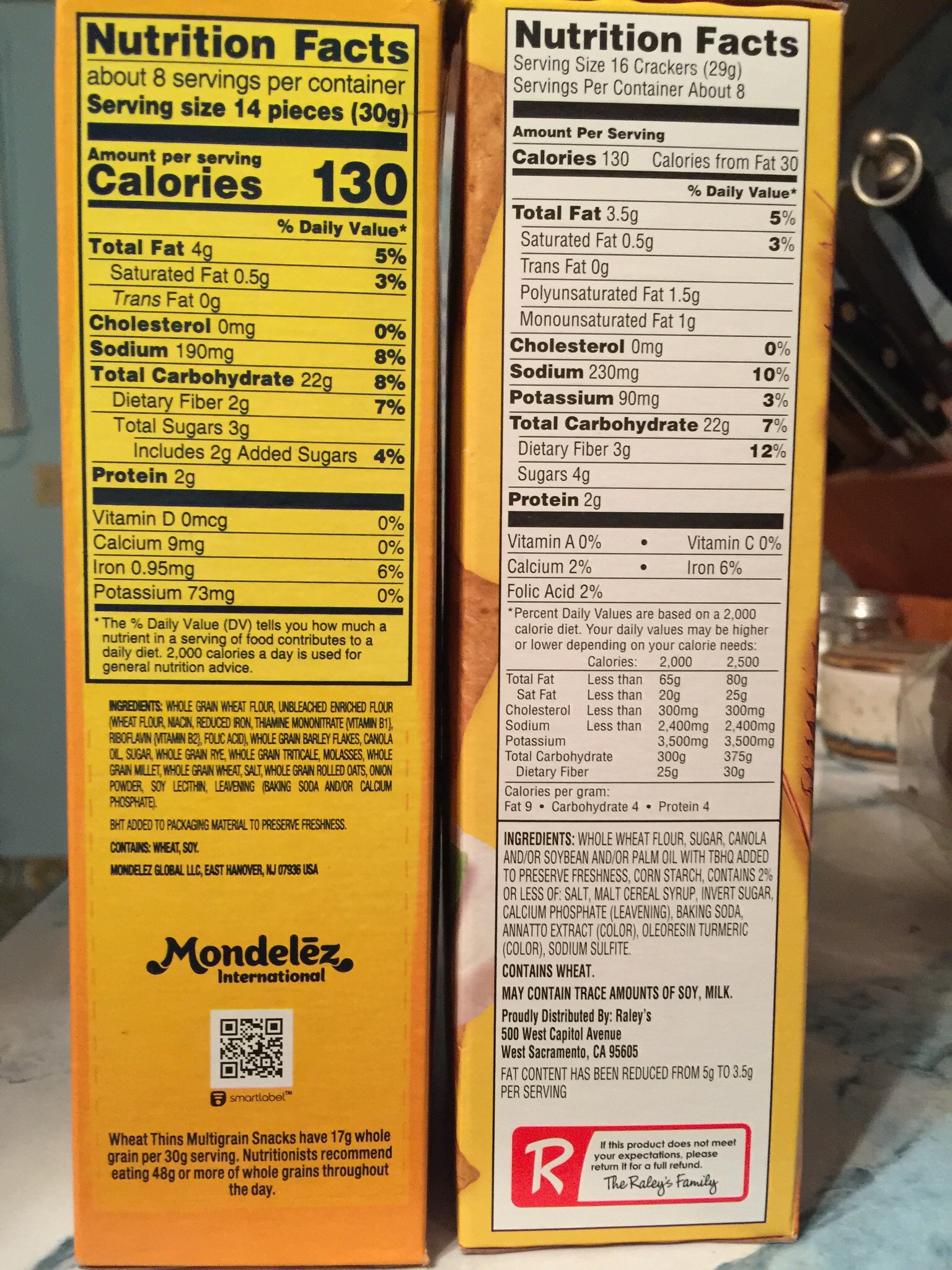
Take a look at the nutrition information on the two boxes to the right. Pay attention to the formatting and design rather than content. What do you notice?
The most important information, the ingredients, is the hardest to read! The ingredients list is typed in one of the smallest fonts on the package. It’s also in narrow ALL CAPS, making it more difficult to read than the even tinier QR label branding on the left-hand box.
Why is the ingredient list the most important information on the box? Many people have medical issues that are caused or exacerbated by certain ingredients. To use an extreme example, trace amounts can cause anaphylaxis, a life-threatening condition. Pets can also be at risk, as shown above. Knowing what’s in your food is thus much more immediately important than calorie counts or vitamin percentages.
Food companies have responded to the prevalence of food allergies by alerting consumers to the presence of a few commonly problematic ingredients. They call wheat, milk, soy, and nuts out separately in bold type. But this is not good enough. They use the same tiny ALL CAPS typeface as in the full ingredient list. Furthermore, there are many other foods that can cause medical emergencies. I used to get anaphylaxis if I ate or drank anything containing gums or resins commonly used as thickeners and preservatives.
When I saw an allergist earlier this Fall, he shared that another patient had anaphylaxis after eating a candy bar. The vital information was concealed underneath a fold in the wrapper, written in type so tiny he needed a magnifying glass to read it.
Ingredients need to be listed in large, clear type in an easily visible location on the package. Not in ALL CAPS. This information, or a QR code leading to it, needs to appear on individually wrapped items. Food purveyors must make it easy to find a complete and accurate ingredient list online. Currently many restaurants make it really hard to find their nutrition information and only include a list of common allergens, not a complete ingredient list. This is a dangerous and unacceptable practice which must change.
In addition, consumers need to be able to easily and quickly identify the date a recipe was last revised. This will alert consumers when they need to carefully review the ingredients again. This is important because when the recipe changes without notice, consumers are at higher risk of injury or death from new, unexpected ingredients.
 Honeycomb's Hive