You may know that knitting requires higher mathematics. Did you know that counted cross stitch also uses high-level math?
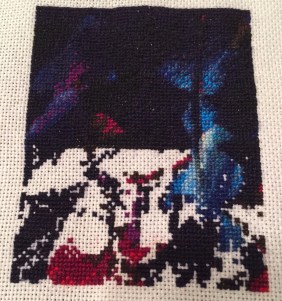 I contemplated this when I noticed a familiar formula appear in my current project. Check out the white space in the photo to the right. To me it looks like 2Πr, the formula for deriving a circle’s circumference from its radius.
In counted cross stitch, needleworkers are constantly solving the Traveling Salesman Problem (TSP). The TSP is important to many industries that depend on logistics and performing complex routing, such as shipping, computer chip manufacturing, and even DNA sequencing. This problem asks, “Given a list of cities and the distances between each pair of cities, what is the shortest possible route that visits each city exactly once and returns to the origin city?” In cross stitch terms, “Given a chart with the location of stitches in color x and the distances between each pair of stitches, what is the most efficient route that uses the least amount of thread?”
This is an NP-hard problem, which means it’s rather difficult. And yet stitchers constantly solve it as they stitch, deciding how to use their thread most efficiently. Doesn’t that make you feel awesome, fellow crafters? 😎
I’ve completed 1/30th of my current project and am moving on to page 2 of the chart! It’s a bit dismaying to see how small it is on 25-count fabric, but I’ll keep trucking. Here’s a pic: 
It looks more like a rectangle in real life. 🙂
 Honeycomb's Hive