
We recently discovered The StoryGraph thanks to ReadWithCindy’s 2021 Asian Readathon (check out our picks here). According to the website, “The StoryGraph helps you track your reading and choose your next book based on your mood and your favorite topics and themes.” Intrigued, we decided to take it for a test drive.
A Few Caveats
We’ve only checked out The StoryGraph on our iPhone, so keep in mind that the desktop version may have features we didn’t get to experience. But let’s be honest, all major features should work on all versions of a site, especially when users can’t opt to switch to desktop mode. If we can’t do it on our iPhone, it might as well not exist. 😆
It’s also important to note the site is still in beta mode and actively adding new features while troubleshooting existing ones. The StoryGraph seems very responsive to user demand and it’s fair to expect many of the limitations we experienced will be temporary.
The StoryGraph Difference: Things to Love
The StoryGraph’s UI is clean and minimalist. We appreciate the calming, uncluttered vibe. It does lack a dark mode, though, so photosensitive viewers may want to use a dark reader. Sign up is quick, easy, and doesn’t ask for sensitive information. We haven’t been spammed since we signed up, either! The StoryGraph can import your Goodreads library for you, but we decided to start with a fresh slate.
Let’s talk about how The StoryGraph stands out from the crowd. Two things are at the heart of the StoryGraph experience: moods and statistics.
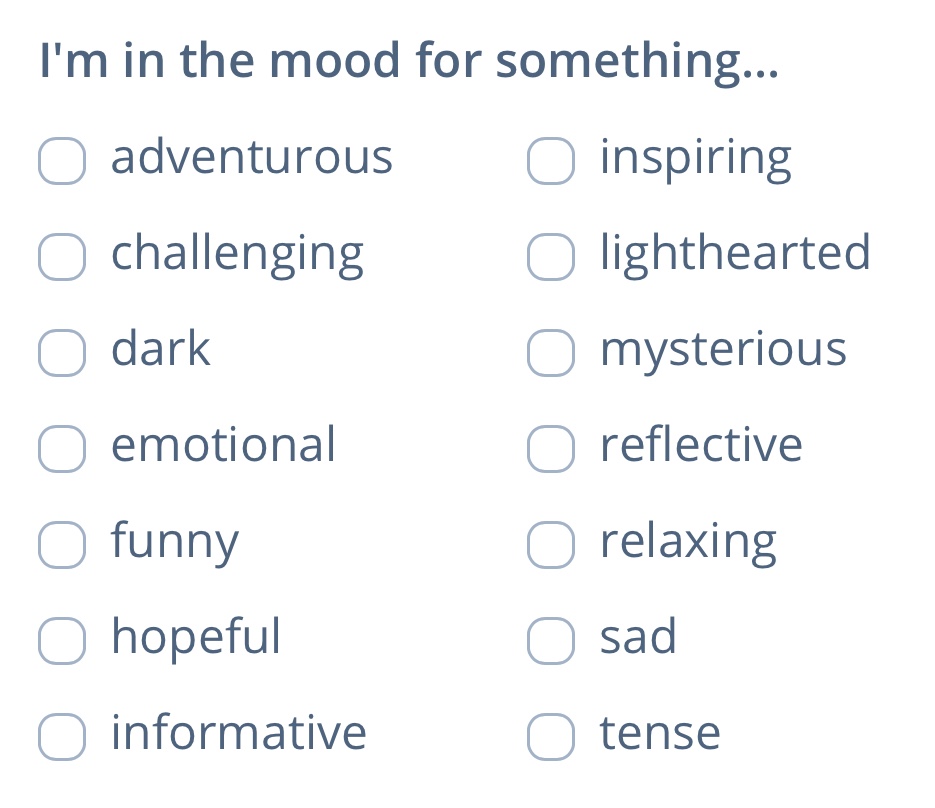
The StoryGraph’s tagline is “Because life’s too short to read a book you’re not in the mood for.” Thus, books are primarily judged on feels. In addition to the mood list to the right, readers can indicate a book’s pace, length, whether it’s plot- or character-driven, and even content warnings. These are great metrics for deciding whether a book is a good fit for you. We’d like a few more mood options, but the current set covers a lot of ground.
We’re especially excited about the ability to flag content warnings! This is extremely useful. You can note whether potentially triggering material is major, moderate, or mild. We would like the ability to do this if we haven’t finished a book, though. What if the material was so triggering we had to stop reading? That’s important information for others to know without having to check out the written review. It should be part of the aggregate data. It also needs to be easier to add content warnings to the menu. The StoryGraph figures this is covered by tags, but as far as we can tell, tags are useless. The tagging function might as well not exist.
Of course, you can rate books you’ve read out of 5 stars, but The StoryGraph lets you do so to a quarter-star level of granularity! You can also add a written review and include links.
The StoryGraph takes all the data you’ve given it about what kind of books you enjoy and generates a reader profile. Even with little to go on, it had us pretty well pegged from the get-go.
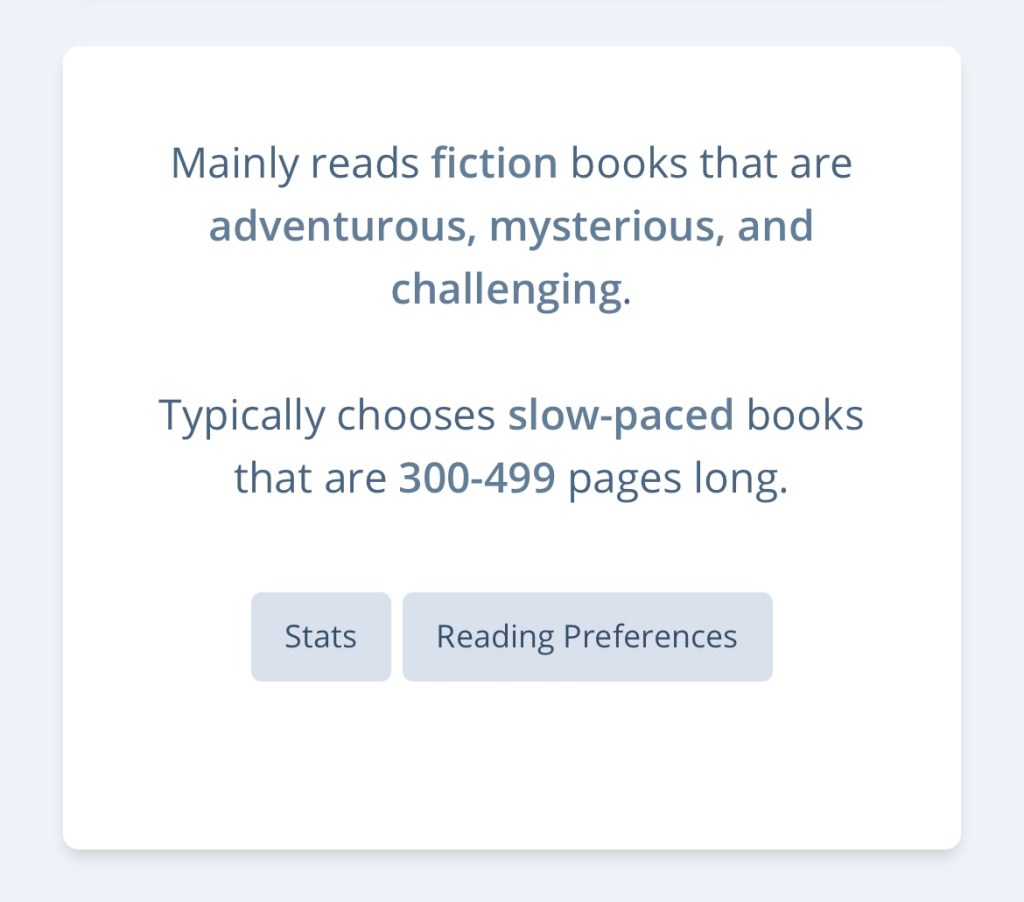
This assessment gets more accurate the more you fill out your The StoryGraph library. Ours changed from the initial, “Mainly Reads fiction books that are adventurous, mysterious, and challenging. Typically chooses slow-paced books that are 300-499 pages long,” to adventurous, mysterious, funny, and fast-paced. The StoryGraph uses this profile to generate recommendations—which are pretty good—and pretty graphs of your reading stats. Unfortunately, there is a lag between updating the profile and the graphs, which can result in confusing mismatches like the one shown below.
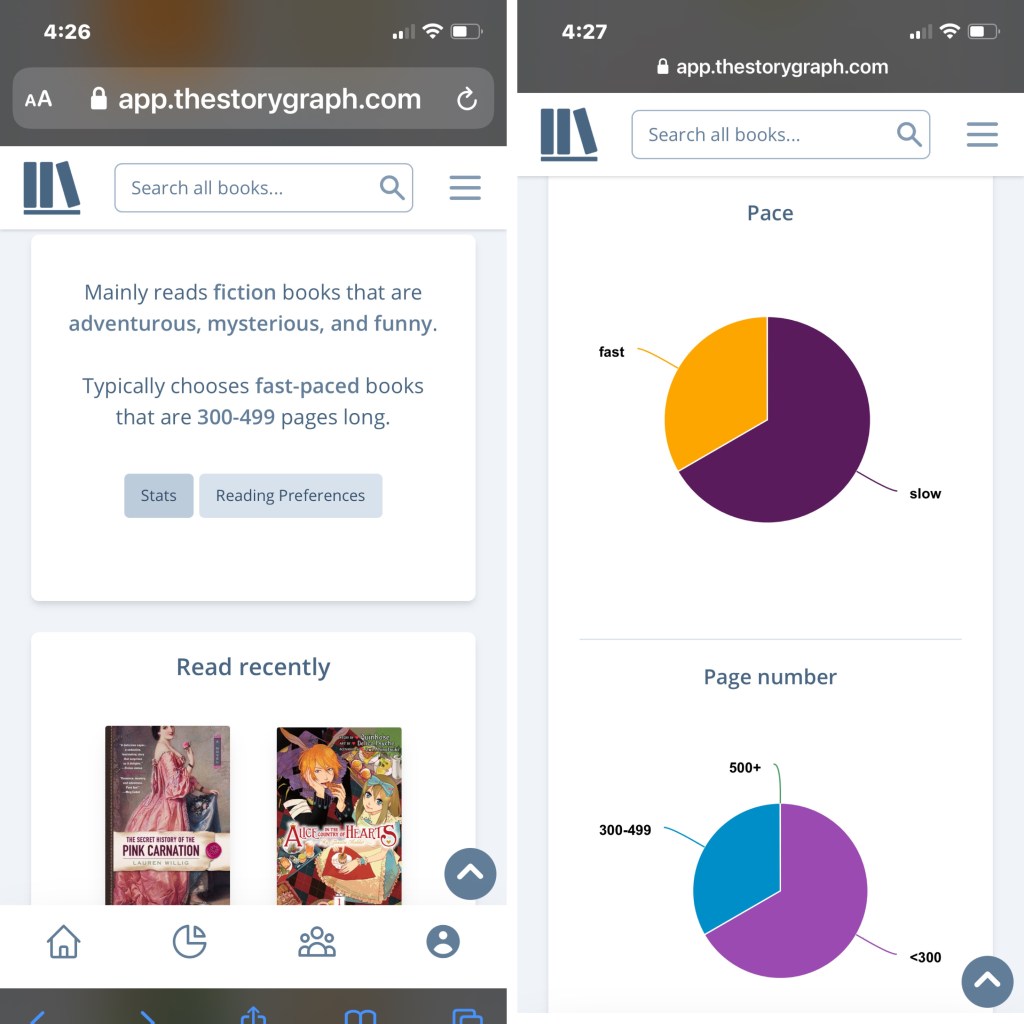
The graphs are fun, though, and the way they crunch the days really does make it easier to find books you’ll love. The StoryGraph also sidesteps the Goodreads toxicity simply by not having a social media aspect. The only way to interact with others on the site is to follow them or join a reading challenge. Even so, it’s at a remove. “This is what I read and what I thought. The end.” It’s rather refreshing and adds to the chill vibe.
We’ve found the biggest reason to stay active on The StoryGraph are the reading challenges. These are a fun way to stretch your reading horizons. When you challenge yourself to read books that fit theprompts, you’ll find yourself adding new authors and genres to your TBR pile! It’s also easy to create your own reading challenges and you can keep them to yourself, share privately with friends, or make them public so anyone can join.
What Needs Work
Navigation overall is clunky. For example, if you use the reading journal feature to jot down a note about your reading and then save it, there is no button to add another entry on the resulting screen. You have to go back to the book’s page and press “track progress” and then “add note”.
It’s easy to search for and add books by title or author using the main search bar. Key word: or. As of this writing, you can’t do both. You cannot filter those results or search for tags. You can only filter results from the “Browse all books” search. As power searchers, we hate this with the same passion we hated Google doing away with Boolean operators. You can’t use the main search bar to find other users or reading challenges, either. That has to be done in their respective sections. Searching by ISBN doesn’t work, unless you’re in the “add a book/edition” dialogs (which, while we’re on the subject, aren’t user-friendly—and we say this with librarian training). The StoryGraph’s selection is mostly English titles that are currently in print. The site also isn’t set up to track journals and periodicals. We want to be able to search for anything using the main search bar, or at least have an advanced search mode that does that. If we have a physical copy, we also want to be able to use our phone camera to “scan” the barcode.
What would’ve been really useful would’ve been a way to import our Audible library and listening history. Unfortunately, The StoryGraph, like all the other reading sites out there, doesn’t cater to audiobook lovers. Their form for manually adding other editions makes it look like they are planning to correct this, since you can manually add an audiobook edition and input length in hours and minutes. We have yet to see an audiobook edition on The StoryGraph “in the wild”, though, probably because you have to add it yourself—a pain in the ass most users won’t have time for.
Even if you do add an audiobook edition, you can only track your reading progress by percentage read. That means we have to look at the progress bar in our audio player and guesstimate. The site should be able to do the math for you; just put in the hours and minutes you’ve listened so far and—lo!—a progress bar appears! But no, they want you to do division in base 60. Hopefully addressing these issues is in the works. We think it would help The StoryGraph stand out as a welcoming site for neurodivergent and disabled readers.
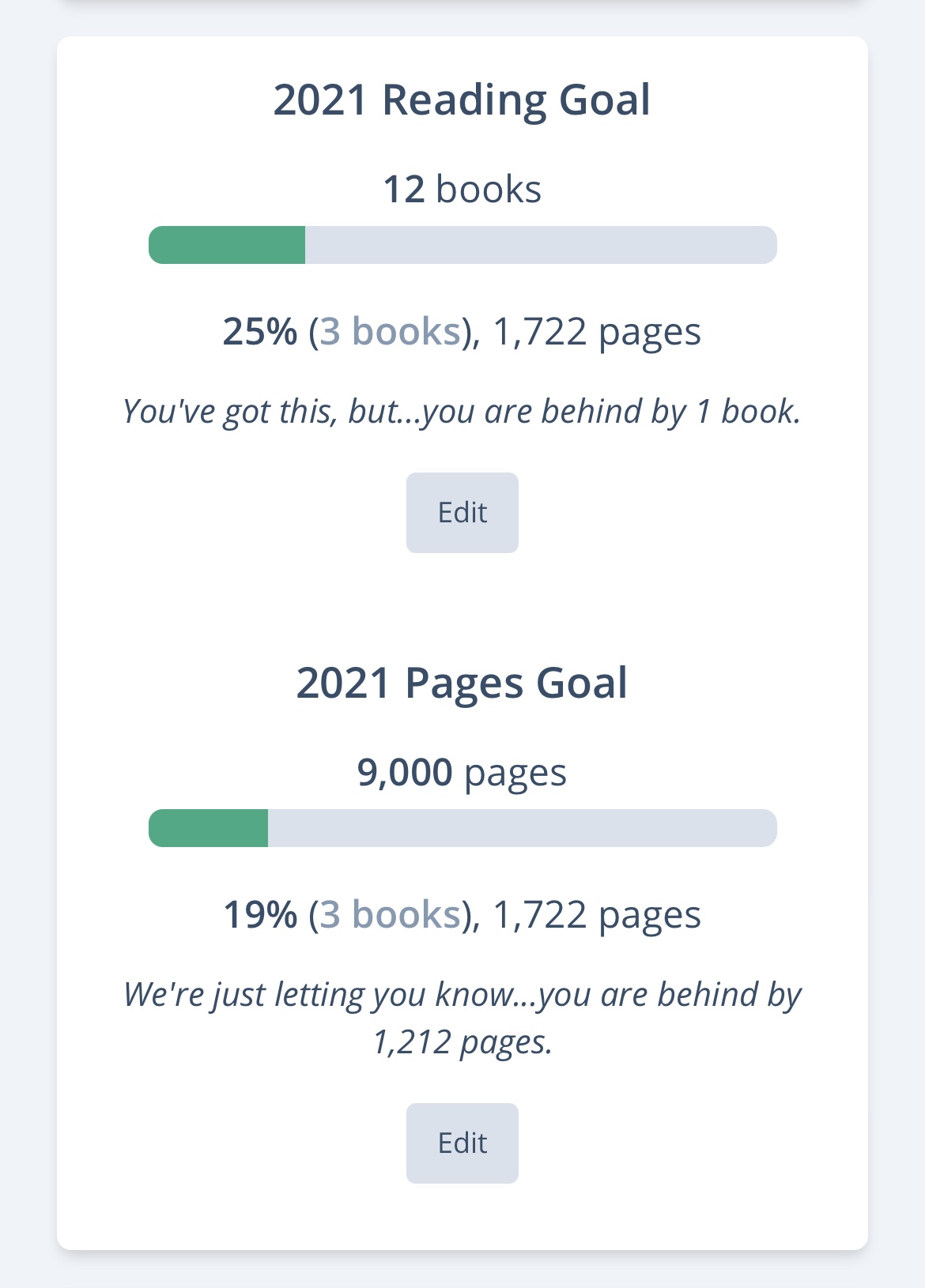
Our final complaint is that whoever designed the books and pages read goals is a sadistic bastard. We are here for fun. We really do not need the site to push our anxiety buttons by telling us we’re behind. Once we took a screenshot for this review, we deleted our goals for our mental health.
TL;DR:
- Being able to find books based on what you’re in the mood for is fabulous!
- Content Warnings! SO USEFUL! It needs to be easier to add CWs that aren’t on the list yet, though.
- Reading challenges are what keep us coming back. They’re great fun!
- Reader profiles, and thus recommendations, are very good with only limited data, which does the strength of their algorithms.
- The site looks pretty and soothing, but needs a dark mode.
- Love the lack of social media features! Makes it a chill, nontoxic environment.
- Navigation is clunky and less-prominent features are hard to use.
- Tags are pretty much useless. The function might as well not exist.
- As much as we love ye olde paper books, The StoryGraph needs to get with the times and support audiobook and ebook readers.
- Whoever designed the books and pages read progress reporting is a sadistic bastard. We do not recommend anyone with anxiety, perfectionism, or workaholism issues use this feature.
- Most of the flaws are probably due to The StoryGraph being fairly new and primarily relying on librarian volunteers. Hopefully they’ll improve if the site continues to grow and gain traction.
Final Thoughts
We think we will be sticking with The StoryGraph for a while and encourage you to check it out for yourself if you haven’t yet! We look forward to the site growing into its shoes, so to speak, and are thrilled to have a site where we can share our love of books without getting overwhelmed by the social aspect.
 Honeycomb's Hive