I was surprised when I came across this article on the BBC News website: “Backlash over illustrator’s black Hermione fan art”. And then I was confused.
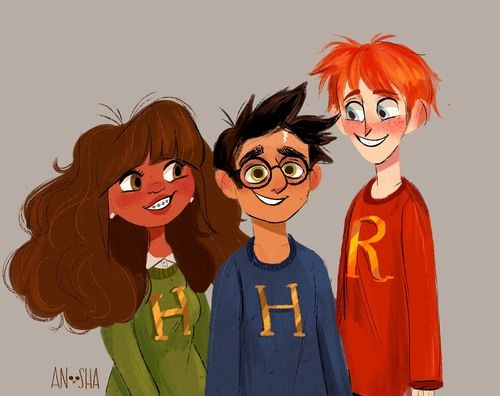
Anoosha Syed’s black Hermione is super cute! But, alas, confusing.
First, I’d like to say that writing a diverse cast of characters with regard to ethnicity, sexuality, gender identity, and so on without making it the focus or raison d’être is one of my goals. I’ve run into some problems because I’m untangling racism I didn’t realize I’d imbibed growing up and because it can be difficult to write the other, let’s be real. I’ve had to realize that you can’t please everybody and I just have to do my best to navigate these issues.
Now, Anoosha Syed argues that J. K. Rowling never states what race Hermione Granger is in the books. The closest she comes is one line in The Prisoner of Azkaban in which her skin is described as brown. So it’s not surprising that readers of all ethnicities would assume that she was their ethnicity. When done consciously, this process is called disidentification. When unconsciously, it’s called ethnocentrism. Syed further argues that Rowling selected a black woman, Noma Dumezweni, to play Hermione in the stage version. The author also retweeted her fan art, giving it the seal of approval.


Rowling’s actions are legitimately confusing for fans. She also selected Emma Watson, a white girl, to star in the film versions. Much was made of Rowling’s power to ensure accuracy in the films. And yet I’ve always been bothered by many inaccuracies that weren’t demanded by changing the medium. For example, in the books all of the Dursleys are clearly described multiple times as blond. Yet in the films they are brunettes. If the actors playing the Dursleys were the best available for the parts, hair dye or wigs could have easily fixed this problem.
So does Rowling herself not have a clear vision of what her characters look like? Does she just not care? Is she content to have multiple versions of her characters?
In a June 5, 2016 interview with The Guardian she says, “It was 17 years and just because I’ve stopped on the page doesn’t mean my imagination stopped.” So if the world of Harry Potter is still vivid in her mind, which casting choice better reflects her imagination?
In the same interview, Rowling addressed the controversy directly. “I decided not to get too agitated about it and simply state quite firmly that Hermione can be a black woman with my absolute blessing and enthusiasm,” she said.
“Can be a black woman.” (Emphasis mine.)
This wording suggests that Hermione was not originally a black woman in Rowling’s imagination, just that she’s okay with her character being portrayed as multiple races. She does not definitively state what ethnicity she had in mind when she wrote the Harry Potter series. So with the evidence at hand, I must conclude that Emma Watson best reflects Rowling’s vision. Watson was cast first and Rowling insisted the film accurately portrayed the books.
I understand Rowling’s impulse to embrace a more multicultural version of her characters. In essence, she is rewriting the Harry Potter series with her choices. And perhaps she didn’t have as much control over the films and play as purported. We’ll never really know. But I think a better and less confusing choice would have been acknowledging a black Hermione is a brilliant idea she wished she’d thought of, and then working to write with a wider color palette.
 Honeycomb's Hive